On January 2nd I described a tour of various locations and monuments within the National Capital Region that are of particular significance or reference to the First Nations. Since then I have learnt of a few others, including one that eluded me on the first tour – the bronze sculpture of an Anishinabe Scout. Here is the route I followed to visit these additional locations.
First stop, 299 Montreal Road where stands the recently completed Wabano Centre for Aboriginal Health, designed by architect Douglas Cardinal who also designed the Canadian Museum of History in Gatineau.
Wabano Centre
Second stop is the sculpture of the Anishinabe Scout at the northern tip of Majors Hill Park, tucked behind the small heritage stone building. The first image also shows the statue of Champlain in the distance up on Nepean Point. The sculpture was originally installed at the base of the plinth upon which Champlain stands but was relocated to its present site in 1996 at the request of Ovide Mercredi, former National Chief of the Assembly of First Nations. UPDATE: December 2018 – Just discovered a very good mini-doc on the history of this sculpture.
Anishinabe Scout & ChamplainAnishinabe Scout
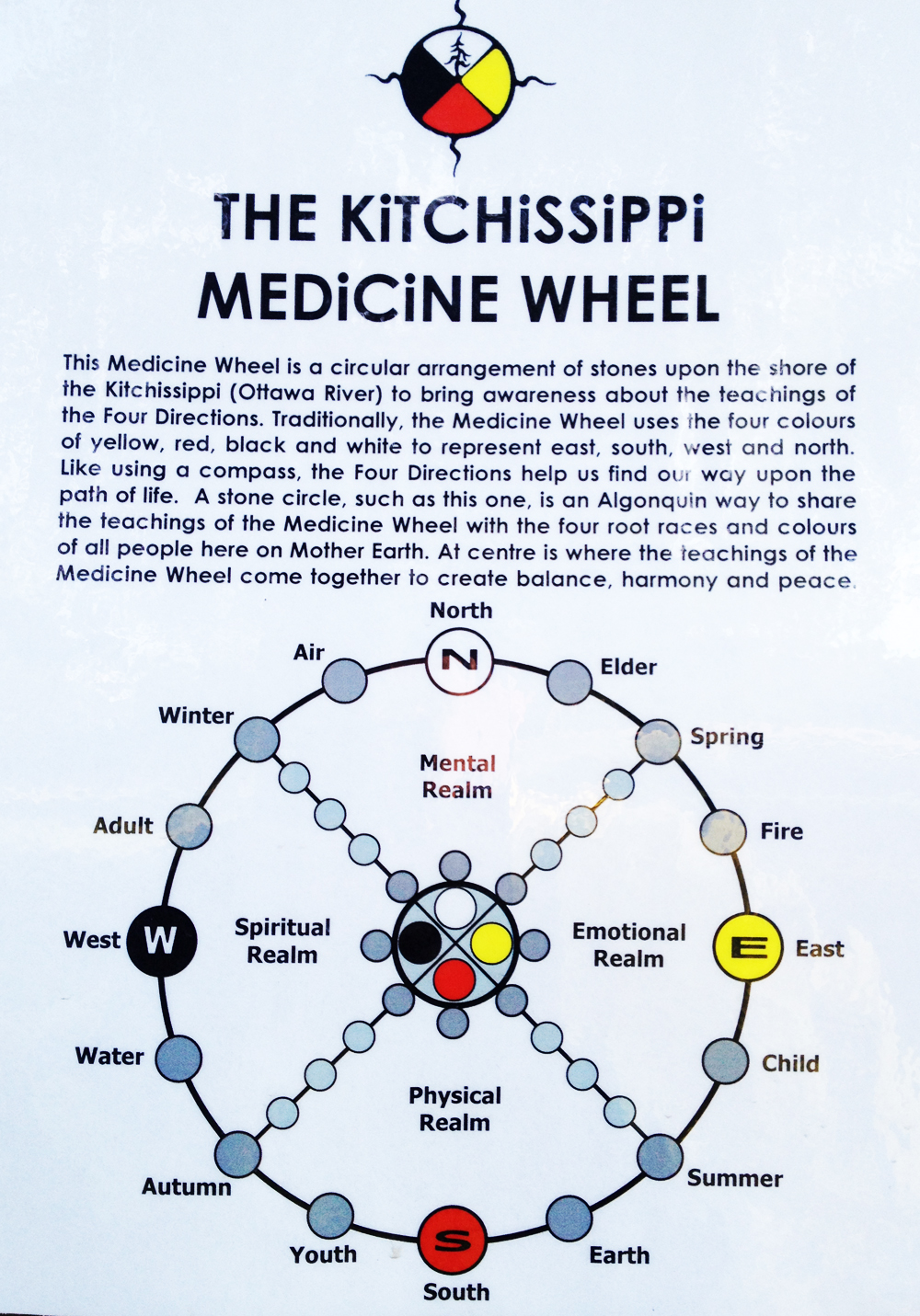
My final stop was along the Ottawa River Pathway, just east of Island Park Drive where this recently installed circular arrangement of stones is located. It is titled the Kitchissippi Medecine Wheel and is the work a fellow named Tim. UPDATE – Summer 2015: The installation is no longer there, but it’s still a great spot to visit, overlooking the Ottawa River.
Kitchissippi Medecine Wheel
This description of the piece is mounted to a wooden post just to the right of the wheel.
After posting my first bike tour of Bruce Garner’s sculptures in and around downtown Ottawa, his wife Tamaya got in touch and generously forwarded me locations of a number of other pieces throughout Ottawa I didn’t know of, or didn’t realise were his creations. Pleased as punch, I subsequently put together this second tour.
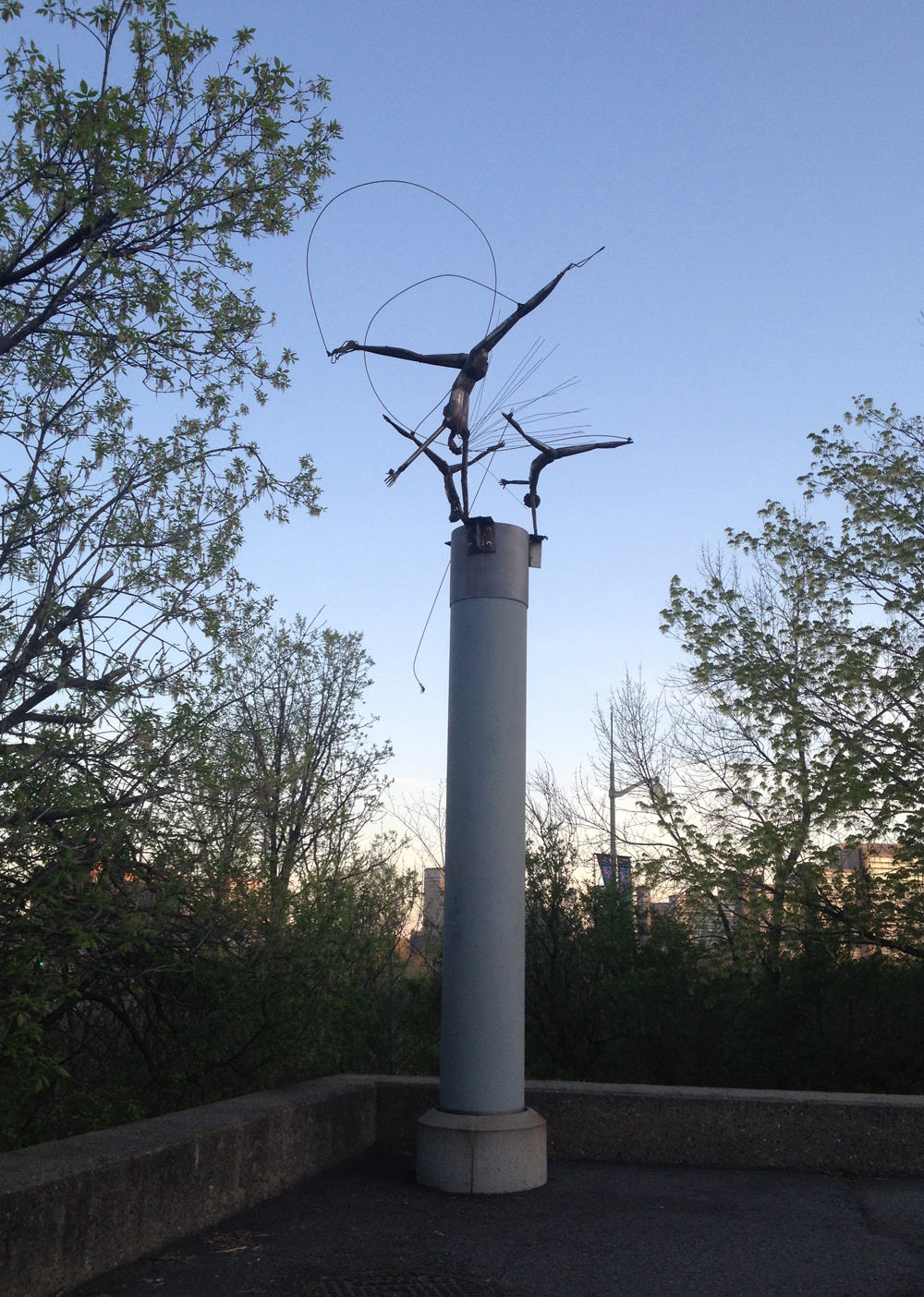
First stop – Children of the Wind, tucked off of Wellington across the street from the Library and Archives Canada building.
Children of the Wind
The next two are in Lowertown. To get there I rode along the Voyageur Pathway on the Quebec side.
Phoenix is located on the lawn of a private home at 152 St Patrick St.
Phoenix
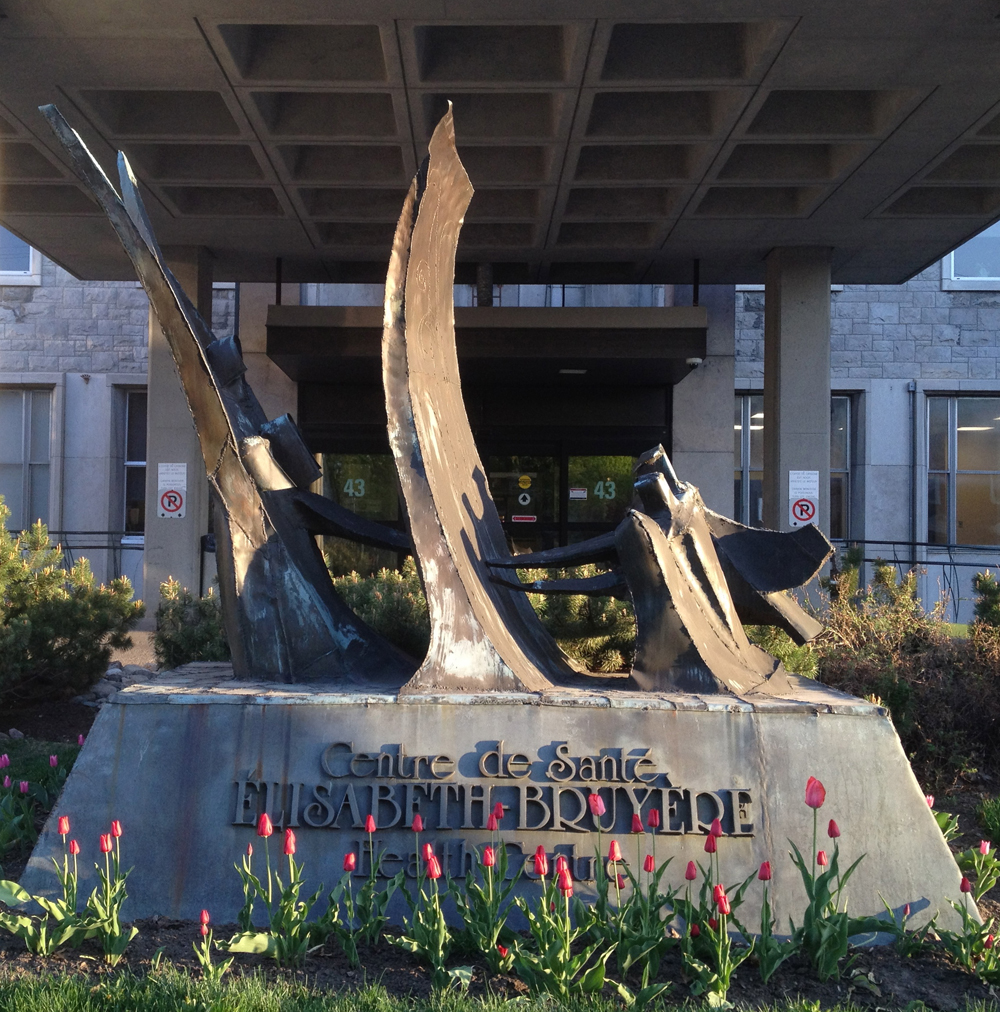
Succor is located a few blocks north at the entrance to the Elizabeth Bruyère Centre.
Succor
Next stop – Ulysses, in the courtyard of the University of Ottawa Arts building. A majestic grouping of figures in a wonderful setting. This has become my favorite of Bruce’s sculptures.
Ulysses
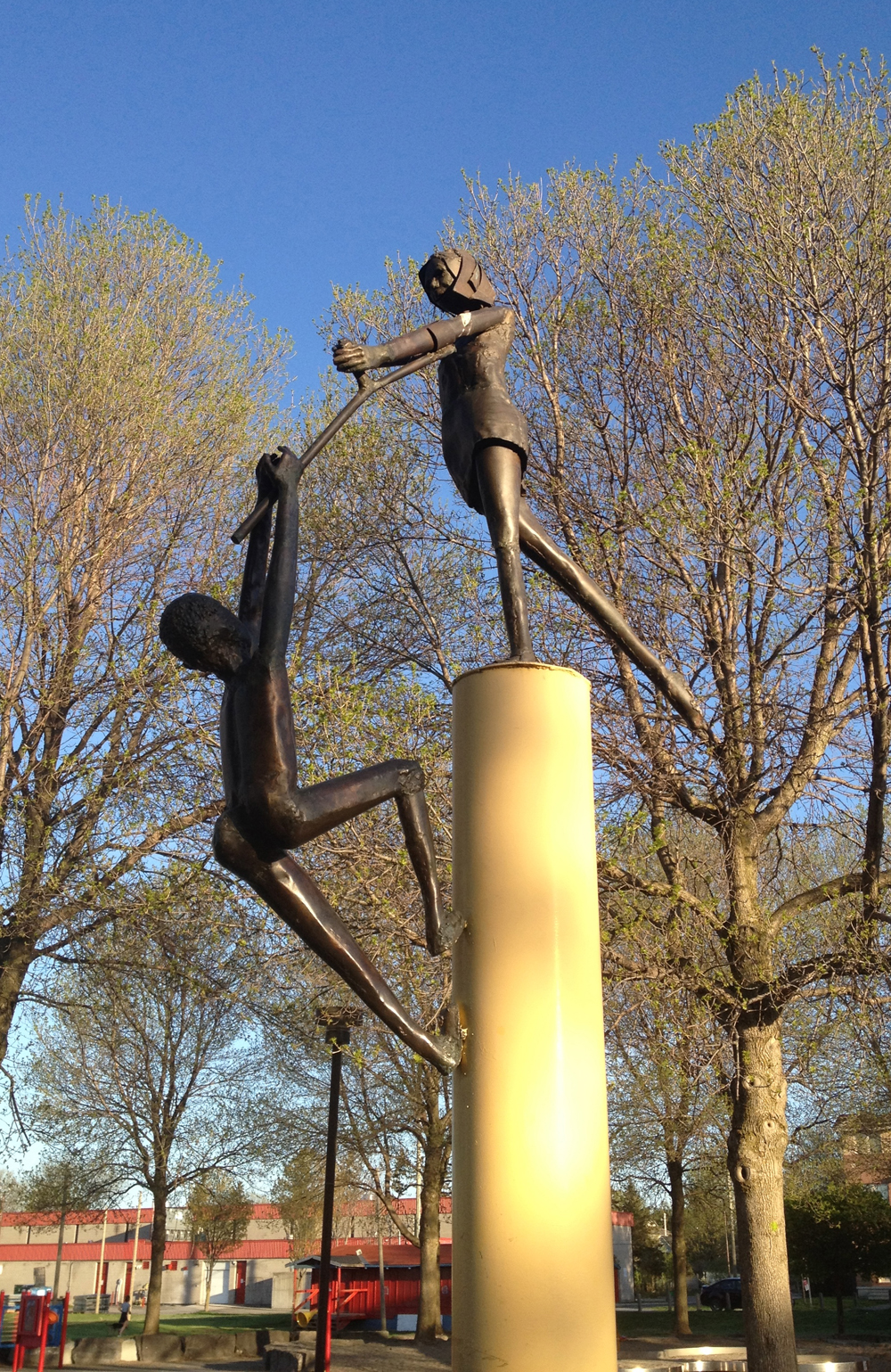
The final sculpture on the tour is Play Pals, located in Brewer Park.
Play Pals
There is also a sculpture Tamaya mentioned located downtown in the World Exchange Plaza, titled Moon Fragments, which I did not include on the tour as it is indoors, however I have marked its location on the map below, along with all of Bruce’s sculptures from tours 1 and 2, for those who may wish to plot a bike or walking tour of their own.{“type”:”block”,”srcClientIds”:[“5373212b-4257-4464-a624-cf1336ce3ca9″],”srcRootClientId”:””}
UPDATE – July 2018: While biking through Barrhaven I discovered this work by Bruce, located on the south-west corner of Malvern Drive and Greenbank Road. I’ve added it to the map below.
UPDATE – March 2021: Here is another wonderful sculpture by Bruce from 1975 located in Ambleside Park, as noted by Tania Garner-Tomas in the comments. Thank you Tania! I’ve added it’s location to the map below.
David Jackson is an amazing multi-faceted local musician and one of the founding members of the Northern Sound Electrical System, ‘an open member project whose purpose is to explore the fringes of drone, electronics, noise and sound through guitars, software, percussion, field recordings, and whatever else anyone wants to bring to the show.’ David posted a great recording of one of their performances at Le Temporaire in Gatineau earlier this year. I had the urge to explore the pathway along the Ruisseau-de-la-brasserie located close to Le Temporaire, while listening to the recorded session, so as the sun came up I set my iPhone SoundCloud app to David C Jackson, North Sound Electrical System Live at Le Temporaire, and headed off. It was incredible. UPDATE Summer 2018: It is now illegal to wear headphones while biking in Québec.
Here’s the route, and some photos taken along the way.
Rue Montcalm bridge
The path dips under a number of major bridges with lots of commuter traffic, the sounds of which lend themselves well to the recording.
Under Autoroute de la Gatineau
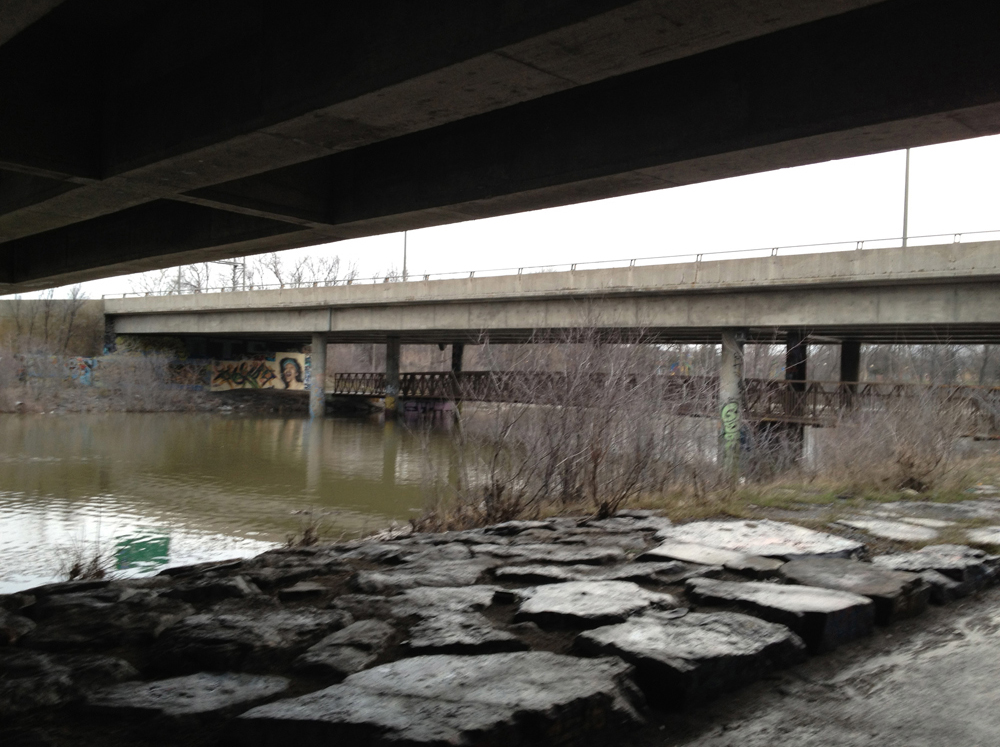
The path splits just beyond Autoroute de la Gatineau. Left continues along the Ruisseau de la Brasserie Pathway towards Leamy Lake, but it’s worth continuing along the right hand path for a bit, at least as far as the bridges that connect the two autoroutes. Here’s some of what what you’ll see.
Under the autoroute connectors
There are two great interpretive exhibits on the shores of Leamy Lake that delve into the history of the area. Conflict of interest warning – Carla designed them.
Leamy Lake interpretive display
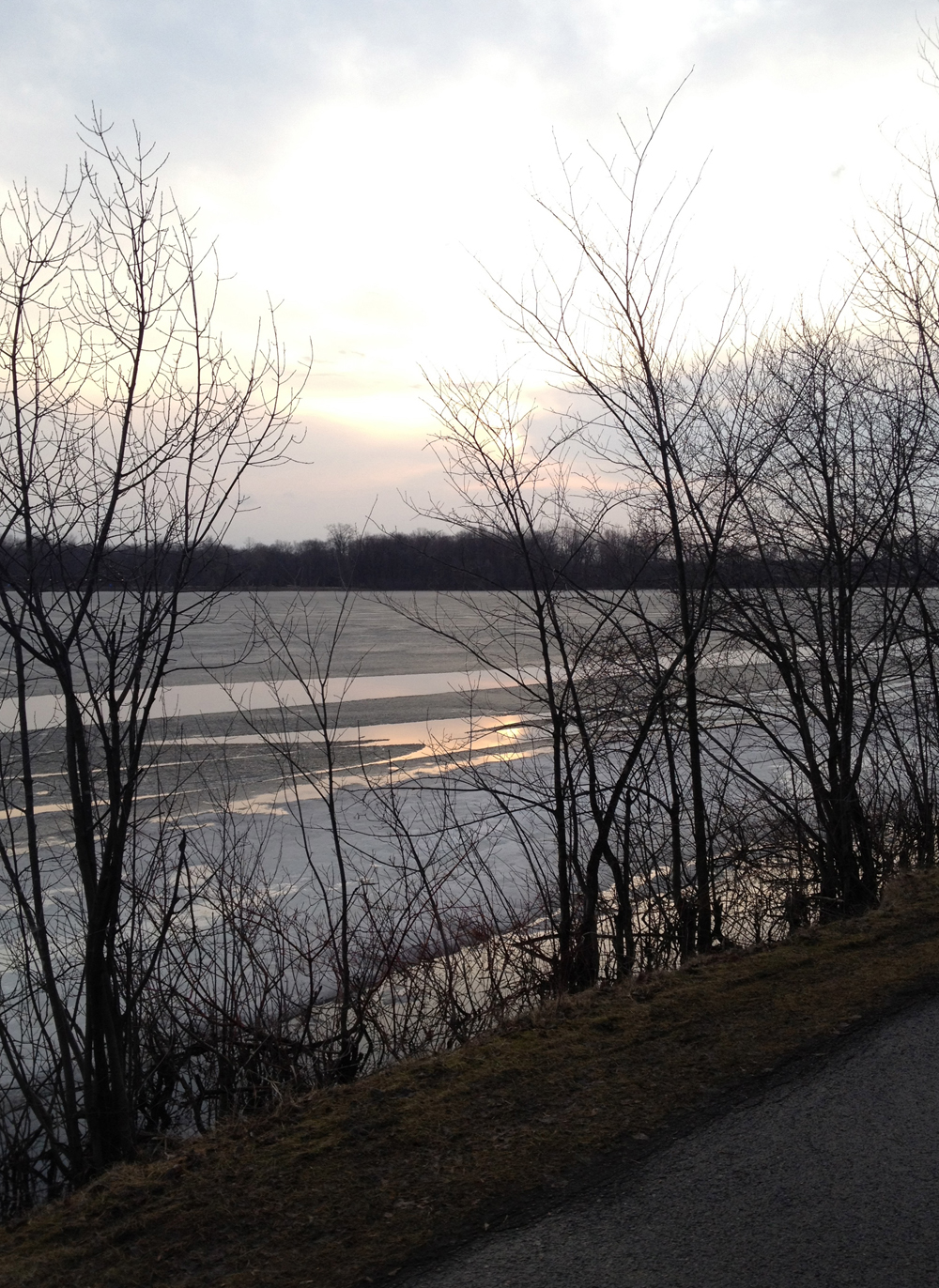
If the breeze is up you can feel the coolness of the melting ice off the lake, as was the case at this spot along the shore.
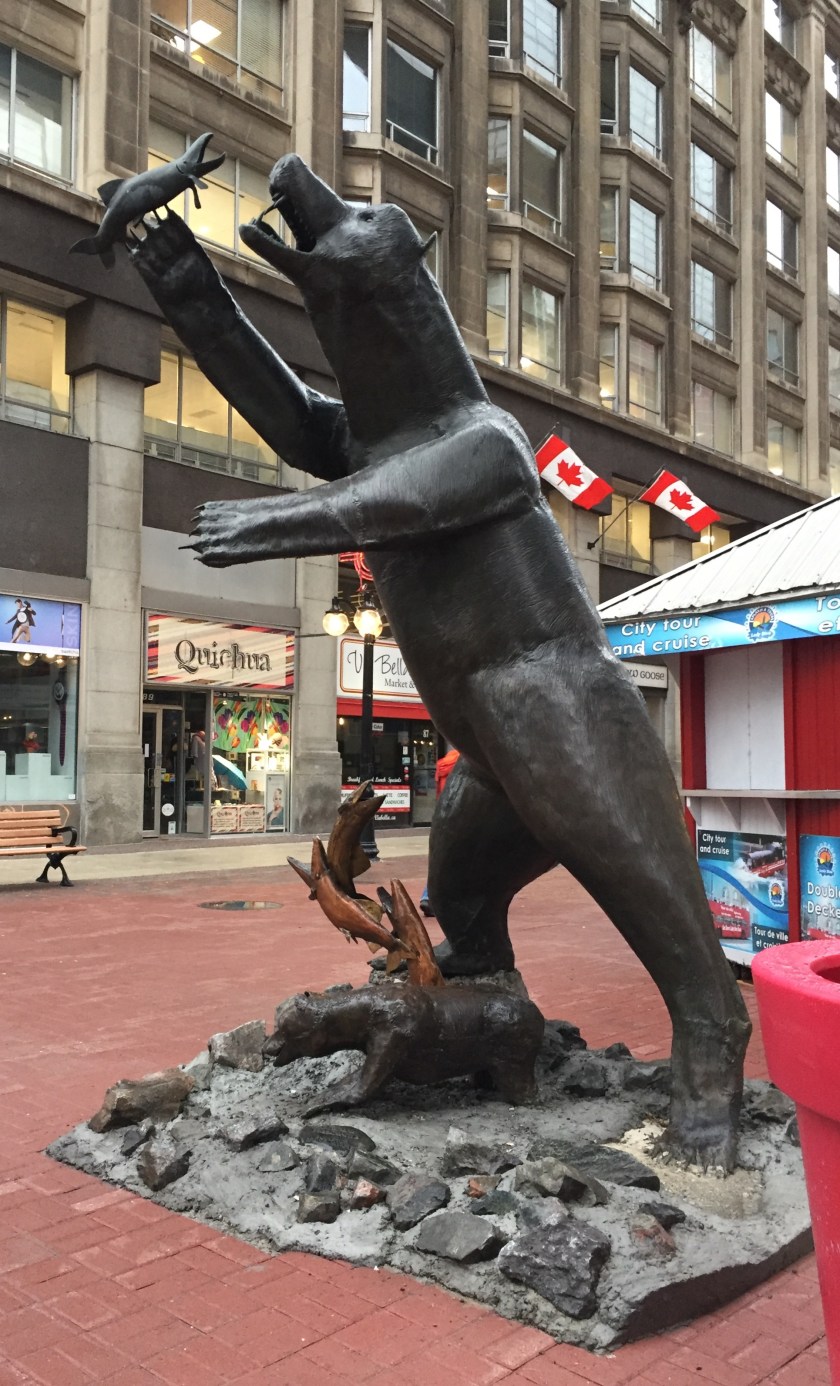
Recent stories in the media surrounding the possible relocation of Bruce Garner’s popular sculpture on Sparks Street of a grizzly bear reminded me of the fine collection of his works installed throughout downtown Ottawa, all within convenient biking distance. So I came up with this tour.
We begin at the corner of O’Connor and McLeod to visit Bruce’s last work, Paso Doble.
Paso Doble
Next stop, Ottawa City Hall, more specifically the southern entrance, where this sculpture titled Outreach sits perched high up on a ledge.
Outreach
Over on Elgin Street, in front of the Provincial Courthouse, you will discover the sculpture Due Process.
Due Process
The next sculpture at the eastern end of Laurier isn’t one of Bruce’s pieces. It is the Lord Strathcona Fountain sculpted by Marhurin Moreau and donated to the city by Lord Strathcona in 1909, however awhile ago I came across an article that described the time and care Bruce and his wife Tamaya dedicated to the upkeep of this iron sculpture. The article spoke of the passion he had for the piece, so I’ve included it in the tour. Unfortunately the article is no longer online for me to link to.
Lord Strathcona Fountain
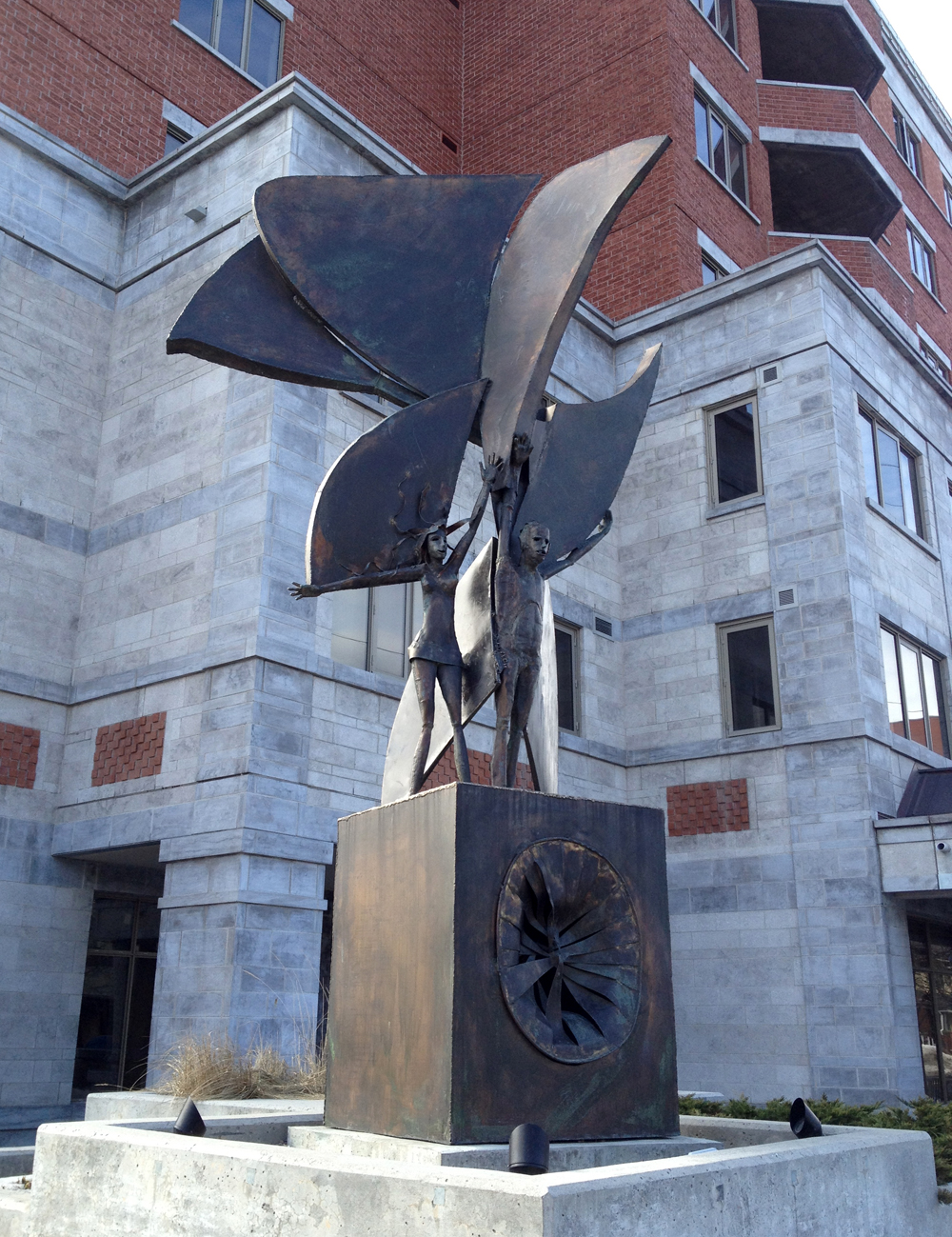
Back into town and over to the Byward Market where from atop the Chum FM headquarters fly these two winged wonders, a piece sculpted by Bruce called Dagain.
Dagain
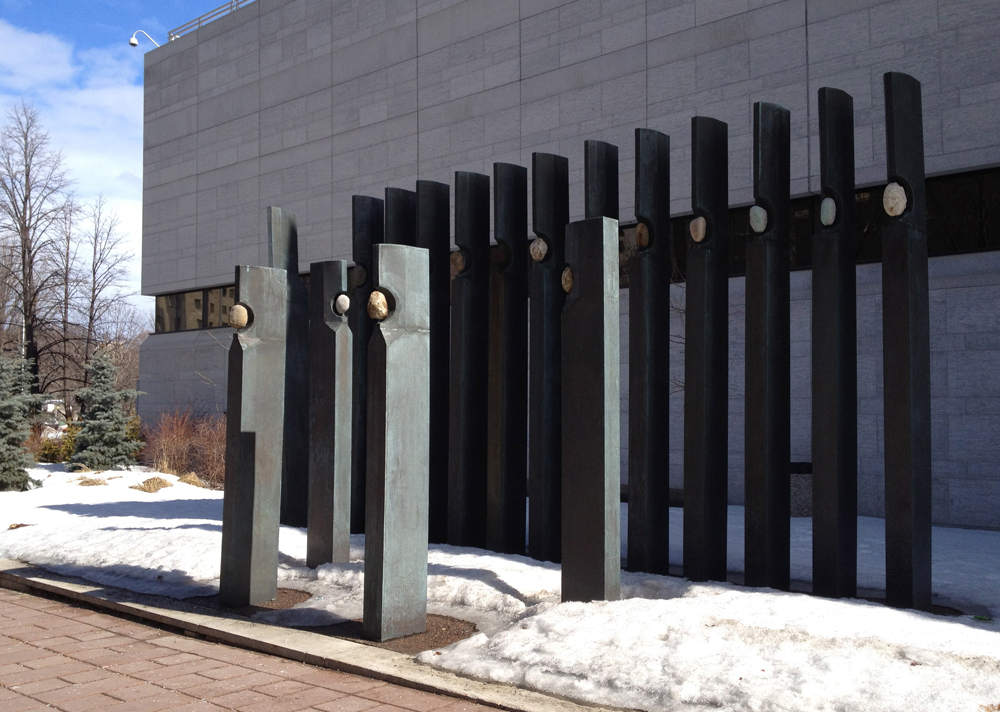
Next, over to Arts Court where sits this sculpture just to the left of the main entrance.
Outside Arts Court
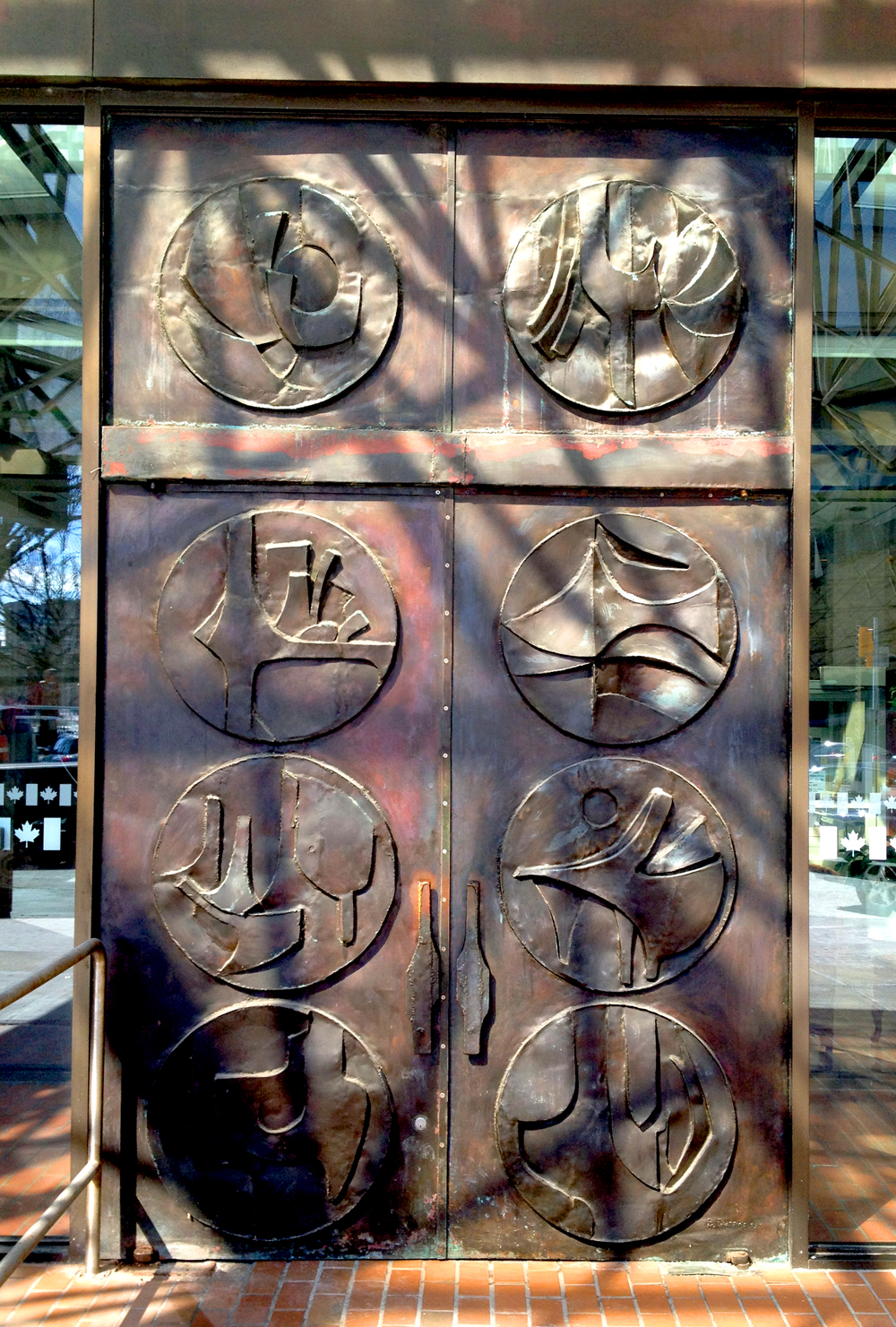
Follow Daly Avenue for a short distance as it dips under the Westin Hotel to the edge of the canal where you will find the Conference Centre. The main doors and transom were sculpted by Bruce out of bronze and copper.
Reflections of Canada
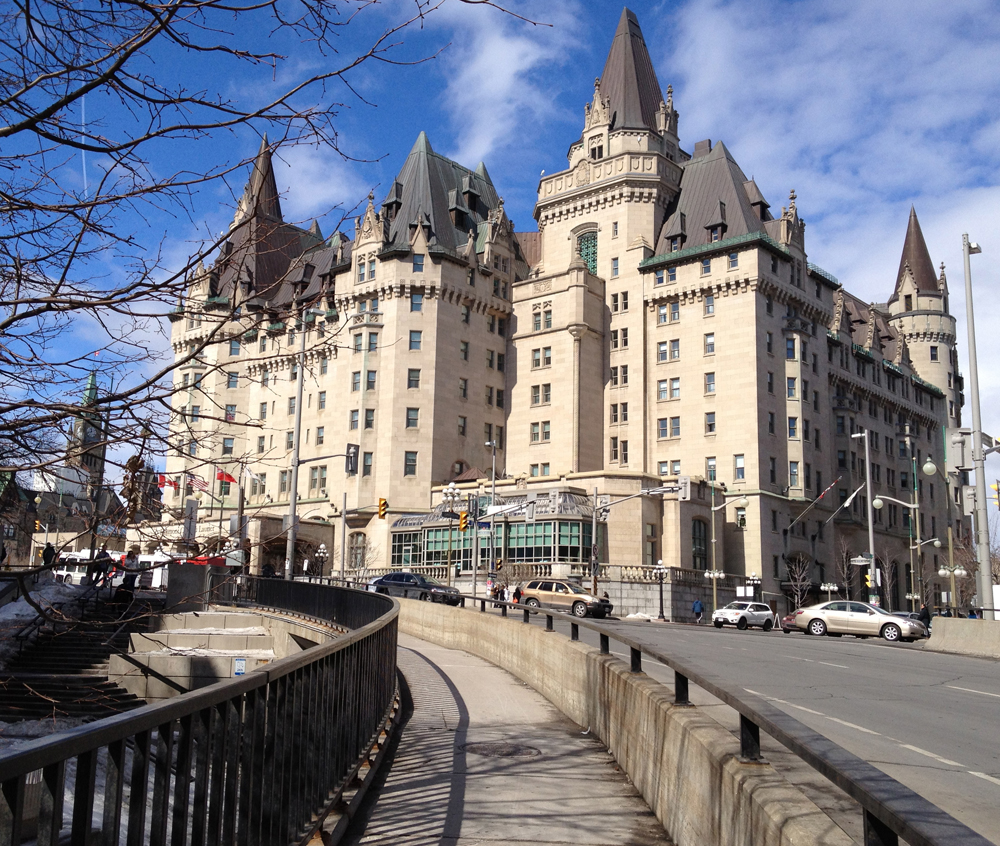
To get to Sparks Street to view the last two works on this tour I suggest walking your bike up along the curved sidewalk, shown in the image below, to Plaza Bridge and continue in front of the Cenotaph over to Sparks Street. I’ve hi-lited this walk in red on the above map. I recommend becoming a pedestrian for this section of the tour because it is far less convoluted and dangerous than trying to weave you way through the usually busy traffic in this area.
Path up to Plaza Bridge
Along Sparks Street, mid block between Elgin and Metcalfe, you will find Joy. As the accompanying plaque describes, it was ‘Donated by E.R. (Bud) Fisher to the Sparks Street Mall Authority and the citizens of Ottawa. Sculptor Bruce Garner.
Joy !
A A bit further west where Sparks meets Metcalfe Street you will encounter the bear. This sculpture was recently relocated to this location from the opposite end of the block near Elgin.
Territorial Prerogative
Thus ends the first tour of sculptures by Bruce. A second tour of other works can be found by clicking here.
There is an isolated pond located at the South end of Brewer Park that has been re-connected to the Rideau River. I’ve never ventured over there as I had always assumed it was inaccessible swampland, but recent aerial photos suggest a path circles around the pond, so yesterday I went and checked it out.
After biking through the Arboretum and pushing my bike over the canal locks at Carleton University, I followed the campus road that runs along the edge of the Rideau River.
I love this spot along the shore.
Train bridge over the Rideau
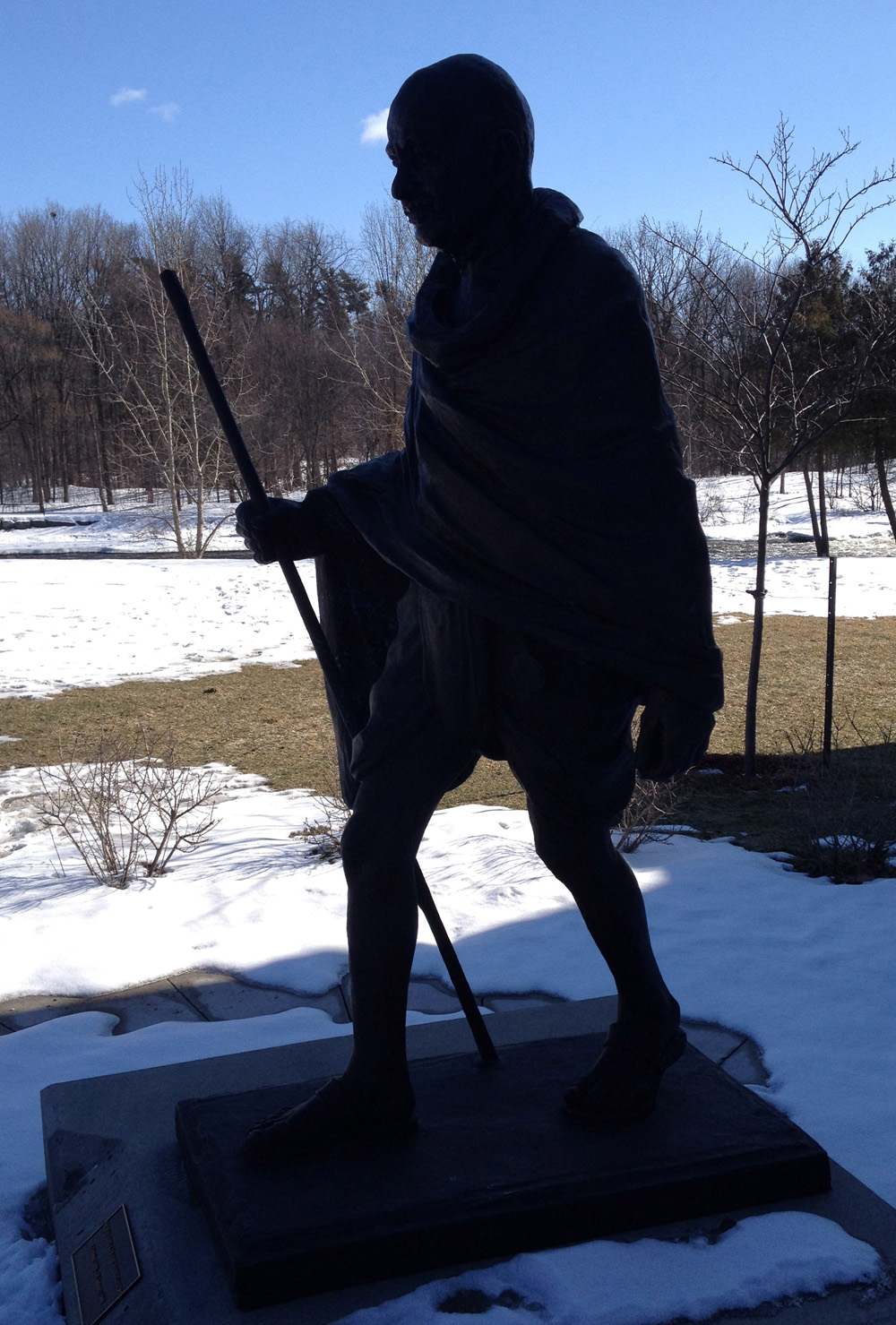
I also came across this statue of Ghandi which had been unveiled by the High Commission of India in 2011.
Lousy photo of Ghandi statue, still recognizable silhouette.
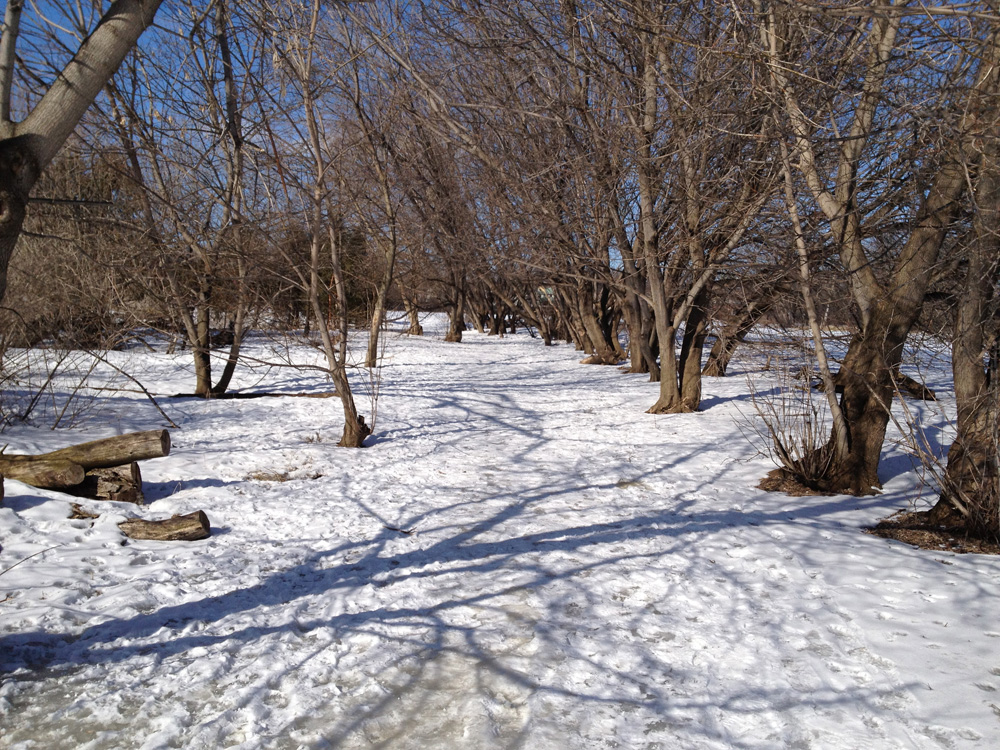
At this point I would like to acknowledge the incredible role dog walkers play in making many snowy paths throughout the city accessible to bicyclists. This winter I’ve come to realise that off-leash dog parks in particular have fine packed paths. This has been the case all winter through the arboretum and, as I discovered on this adventure, along the path from Carleton U under Bronson Avenue and around Brewer Park Pond. The path begins where University Drive turns away from the river.
Path along the Rideau River
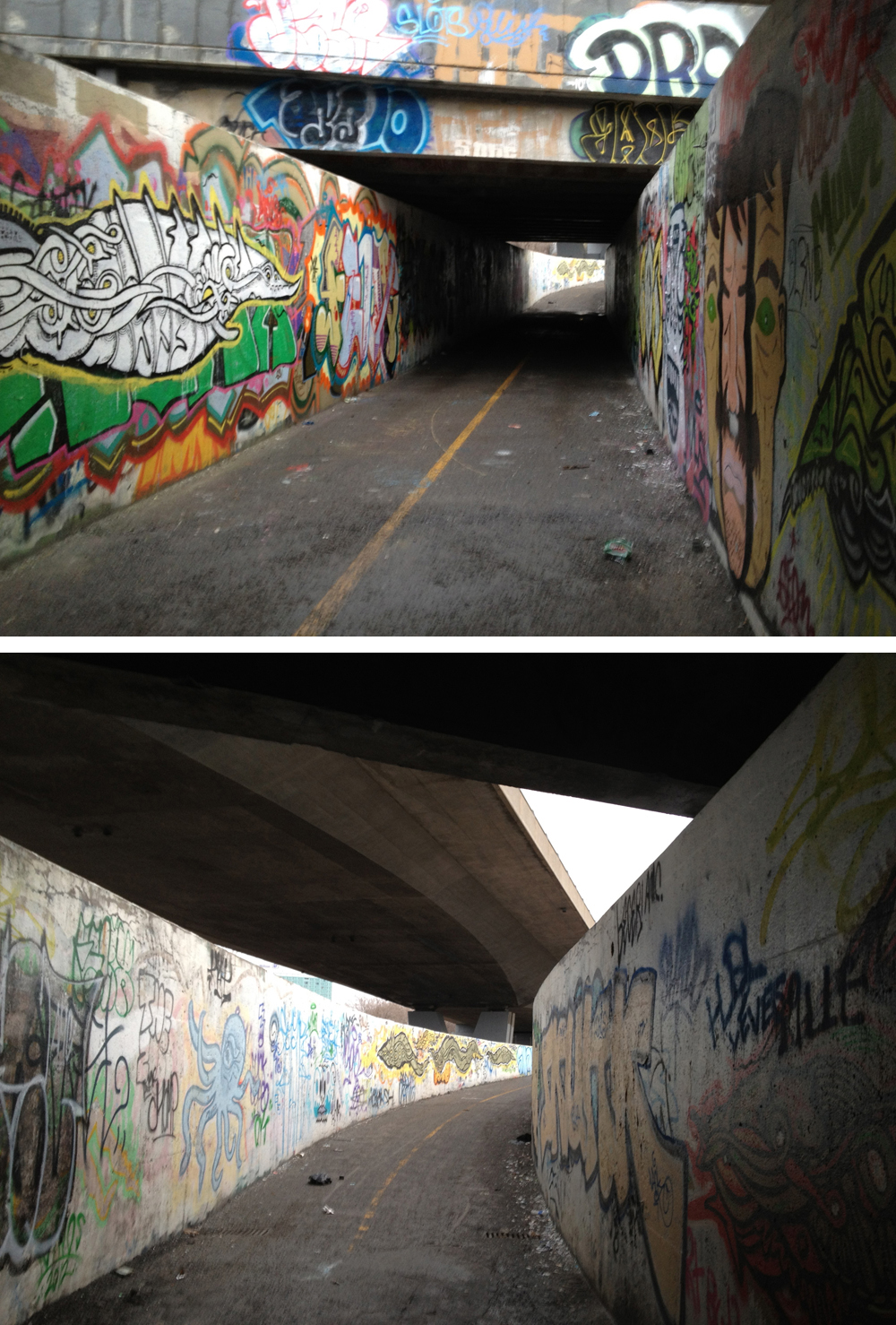
The path continues over a little wooden bridge before arriving under Bronson, where you are treated to THIS!!
Graffiti wall under Bronson
And that’s just 1/4 of the paintings which surround you when you are under the bridge. This is where the annual House of Paint festival is held each summer, although the graffiti changes on a much more regular basis.
The path continues along the shore and Brewer Pond appears on your left, like so.
Le pond
The pond was formed in the 60’s to create a closed in beach and swimming area. The building up on stilts in the distance was the canteen. Shortly thereafter enclosed beaches were deemed unhealthy and this one was closed in the 70’s. Now plans are afoot to re-connect the pond to the river.
Here’s how a section of the path appears as it circles the pond.
Path around the pond
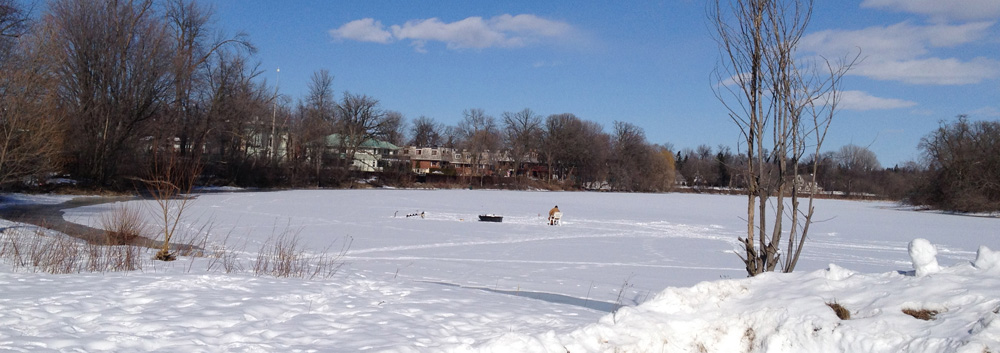
This fellow was out ice fishing on the river, just downstream from the pond.
Fishing on the Rideau
So there you have it – a fine discovery.
P.S.! Here are a couple of photos Carla took around the pond earlier this winter while Nick had a 7am practice at Brewer Arena.
As I write, Chief Theresa Spence of Attiwapiskat is in her 23rd day of her hunger strike on Victoria Island halfway across the Ottawa River. The following press release re-iterating her cause was sent out on New Years Eve.
The entire National Capital Region is of significance to the First Nations as they were its occupants and guardians for thousands of years before Champlain visited in 1615. On Monday I toured a few sites and locations with specific reference to the First Nations. Here’s how.
First stop was the Odawa Friendship Centreon Stirling AvenueUPDATE – The Odawa Friendship Centre has moved to 250 City Centre Ave, The Centre’s mission is ‘To enhance the quality of life for Aboriginal people in the Capital region. To maintain a tradition of community, an ethic of self-help and development as well as to provide traditional teachings from our elders.’.
Odawa Friendship Centre
Around the side and back of the centre are the following murals.
Murals outside the Odawa Friendship Centre
Next stop, Victoria Island, or Asinabka. In the Algonquin language the word “Asinabka” means “place of glare rock”. It is considered a sacred site, where for thousands of years ceremonies and offerings have been made. Lots more on Asinabka here.
The cedar fence was constructed to house a summer interpretive program called Aboriginal Experiences. The tee-pee is where Chief Theresa Spence is holding her fast.
A bit further down river sits The Canadian Museum of Civilization, designed by architect Douglas Cardinal who is of Metis and Blackfoot heritage. His First Nations background is said to have greatly influenced his indigenous style of architecture, as described in this CBC radio interview.
Entrance to the Canadian Museum of Civilization
Back over on the Ottawa side, behind the National Gallery, atop Nepean Point stands this statue of Champlain looking out over the Ottawa River. There used to be a bronze sculpture of a kneeling Anishinabe scout at the base of the plinth on which Champlain stands, but it was removed in 1996 at the request of Ovide Mercredi, former National Chief of the Assembly of First Nations. I did not know that the sculpture of the scout had been relocated to Majors Hill Park a short distance away.
Champlain
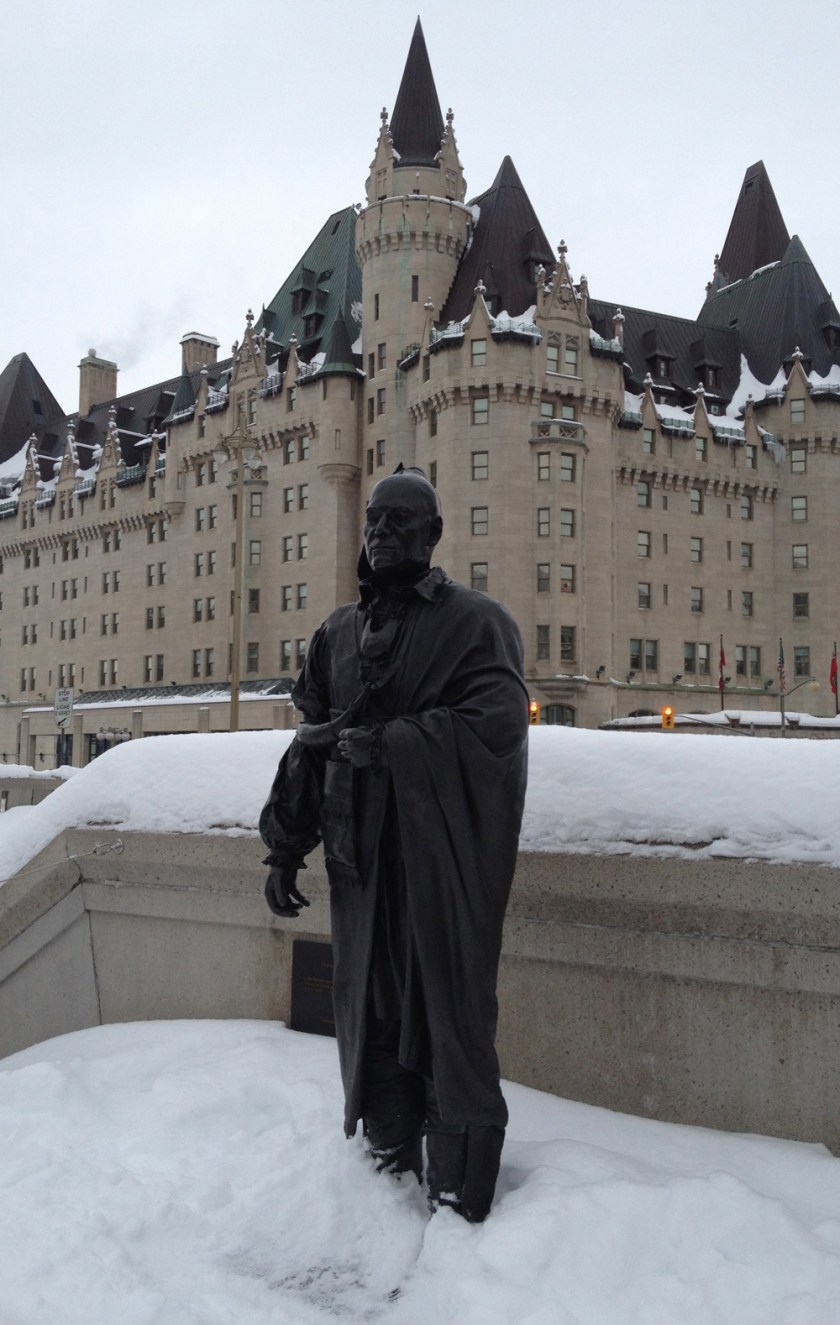
Near the National Cenotaph is the Valiants Memorial made up of a number of sculptures of key figures from the military history of the country, including that of Thayendanegea or Joseph Brant, a Mohawk who supported the British during the American Revolution. He relocated to the area near the present day City of Brantford in southern Ontario after the revolution.
Thayendanegea
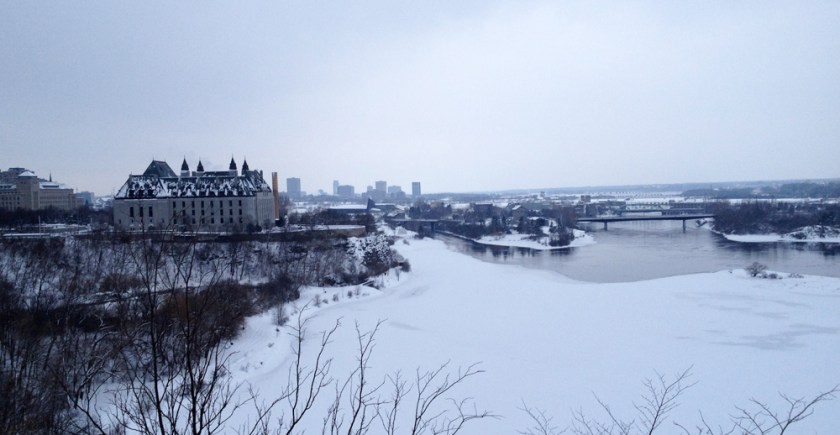
I then rode up behind Parliament Hill to photo the Ottawa River, the highway used by First Nations for millennia before more modern forms of transport took over, first by rail, and now by road and air. There is Victoria Island in the middle, with the Supreme Court on the cliff to the left.
Ottawa River
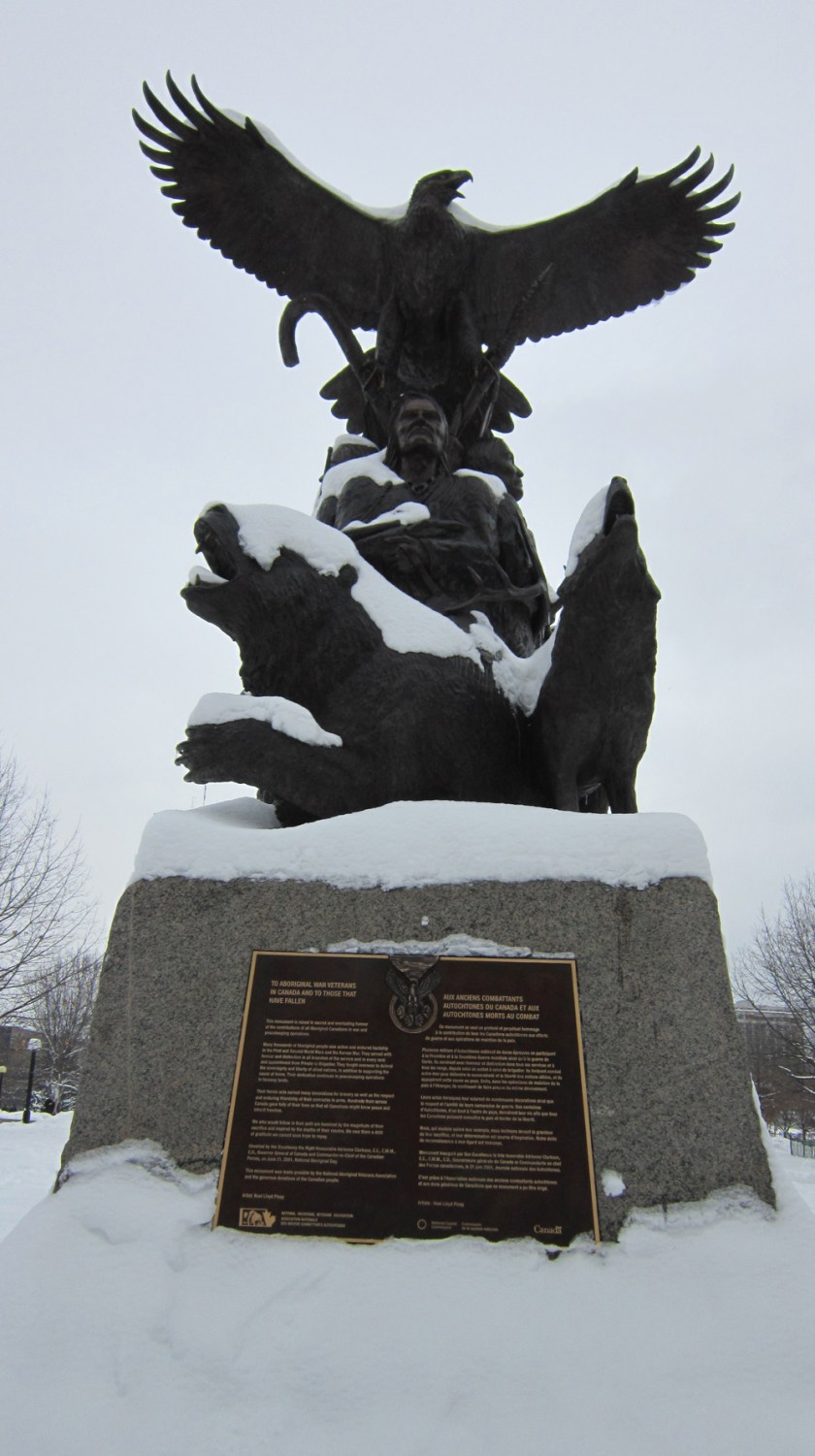
My final stop was in Confederation Park where stands this monument ‘To Aboriginal War Veterans in Canada and to Those That Have Fallen’.
Yesterday was a wonderful day for a trip to the Museum of Nature.
After dropping off some books at the downtown library I biked along O’Connor to meet Carla and the kids at the museum. Now O’Connor is a street I would normally avoid as many drivers tend to zip down this one way street or impatiently jostle each other in their rush to get to the Queensway, but there isn’t much Ottawa traffic on Sunday mornings so I wasn’t too worried.
This view down O’Connor makes it appear as if bland mid-rise buildings dominate the street. This Urbsite post describes the boom in Centretown apartment building in the sixties that contributed to this image.
O’Connor Street
But tucked in in amongst these mid-risers are a number of jewels, such the City of Ottawa Public School Board’s old administrative building at the corner of Gilmour Street. Urbsite once again comes through with this post which not only describes the building, but the two big blue spruce flanking the entrance as well, and how this same entrance was incorporated into a logo used on Ottawa elementary school report cards in the’50’s.
Ottawa School Board building
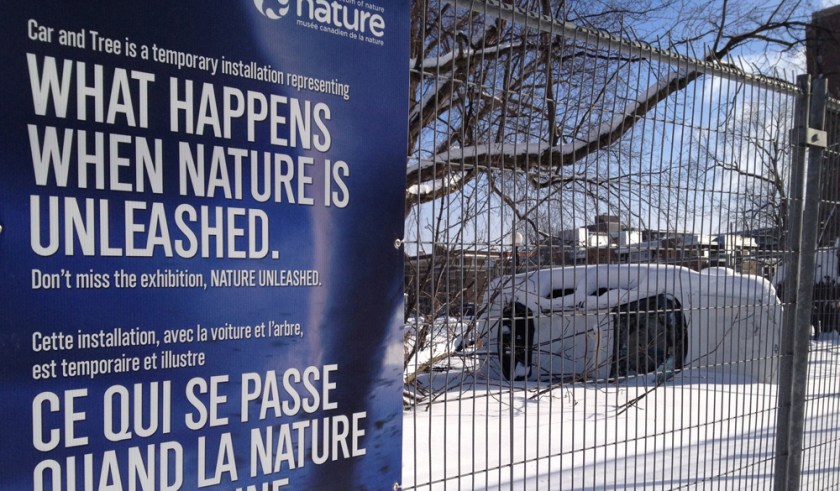
As I closed in on my destination, Pleased with my safe journey along O’Connor, I was shocked to see this smashed up car at the corner of McLeod and O’Connor!
Fooled me. Very clever.
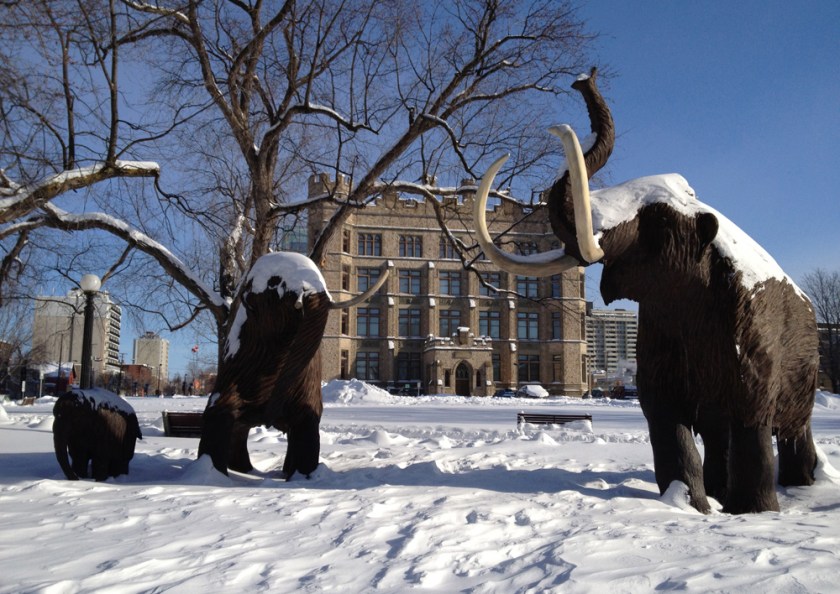
Right beside the faux crash site stand our faithful family of wooly mammoths that have been foraging on the grounds of the museum for as long as I can remember.
Wooly mammoths
On the opposite side of the street sits this great sculpture called Paso Doble by Bruce Garner.
Paso Doble
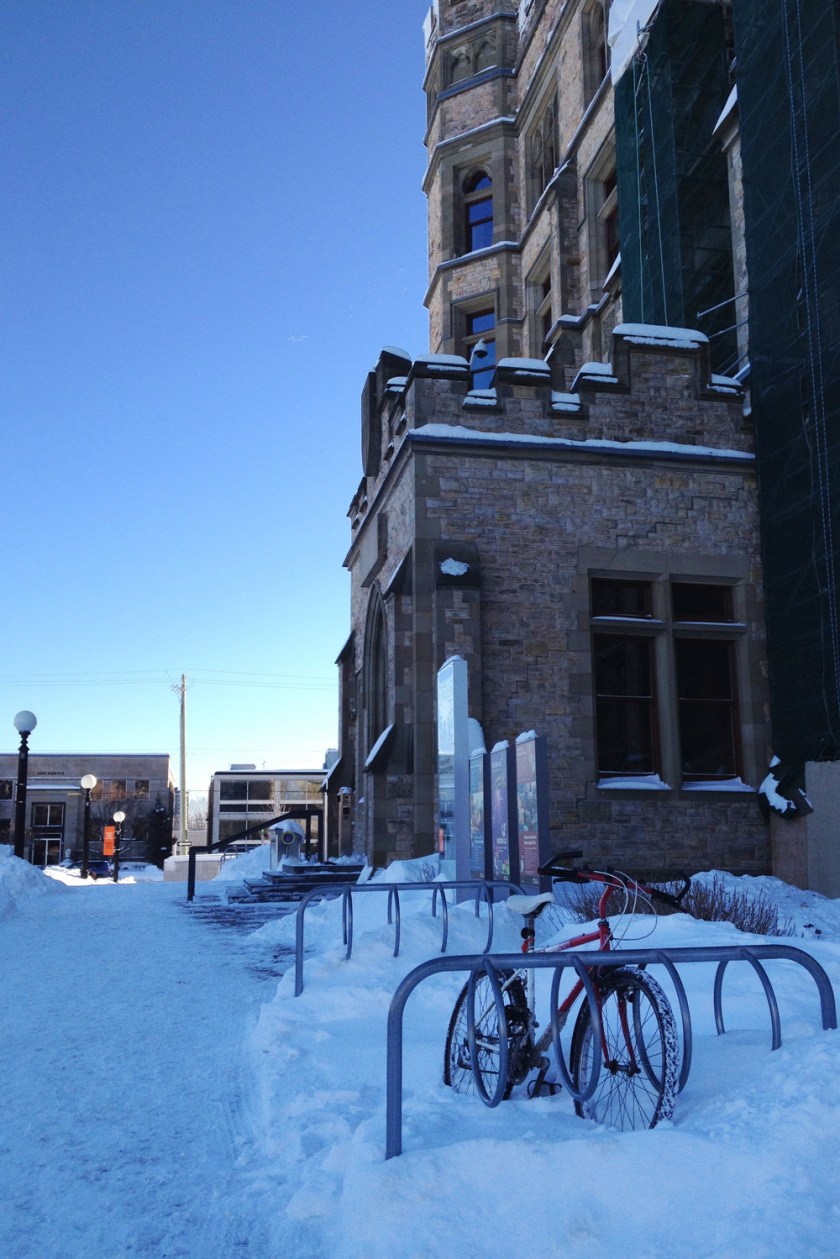
On the east side of the museum there are BIKE RACKS!
Yeah bike racks!
They’ve done a great job with the renovations to the museum. Here’s a view looking up from the old space into the new, of the gang looking down from the new into the old.
Old & New
Rode home safely along Metcalfe and Somerset. A fine outing.
My goal is to pedal down every Ottawa/Outaouais street at least once. For some streets, once is enough. Like Slater Street and Queen Street, which I rode along yesterday morning. They are not very bike friendly, regardless of the green bike ROUTE signs fastened to the occasional telephone pole. But they ought to be safe to bike down for folks who work there, live there or need to ride down them for whatever reason.
My destination was the old post office at Sparks and Elgin to mail off Christmas gifts. Blue line’s how I got there. Red line’s how I got back.
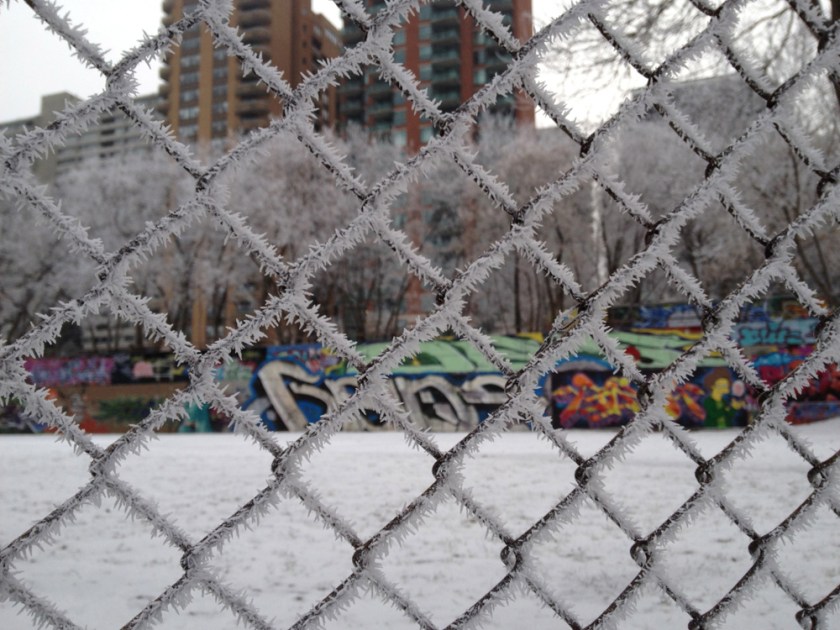
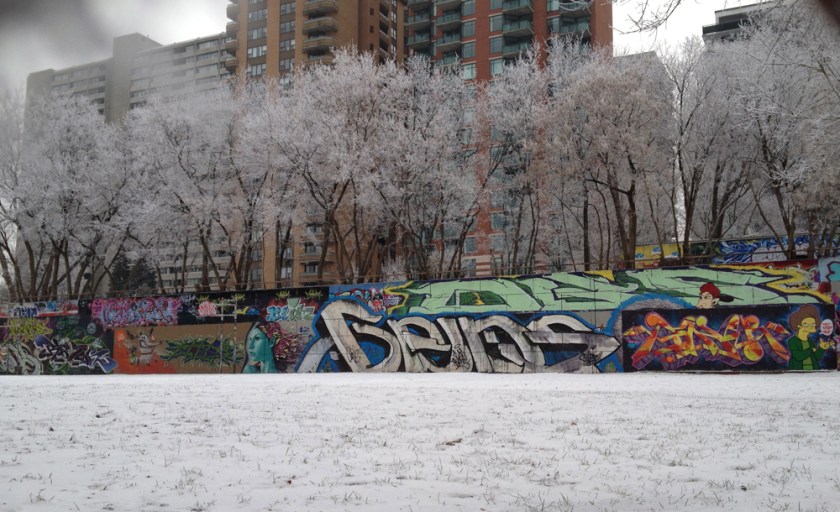
At the corner of Bronson and Slater there is a very wide graffiti wall. Here’s how it appeared through the frost covered chain link fence.
Graffiti wall along Slater
Slater is three lanes heading east one way. The south side is pretty much a transit way, forcing bicyclists to hug the shoulder-less curb on the opposite side. Drivers instinctively consider this outside lane to be the passing/speeding lane. Pretty nasty.
Slater St
I was pleased to turn up Elgin Street and see Oscar sitting outside the NAC covered in a frosty layer. This wonderful commemorative statue by Ruth Abernethy is extremely welcoming. I often see folks sitting on the piano bench beside Oscar, listening to his music coming from speakers placed up above.
Oscar Peterson
Construction scaffolding and plywood presently surrounds the main entrance of the post office at Sparks and Elgin, caging in this noble sentry.
Caged Lion
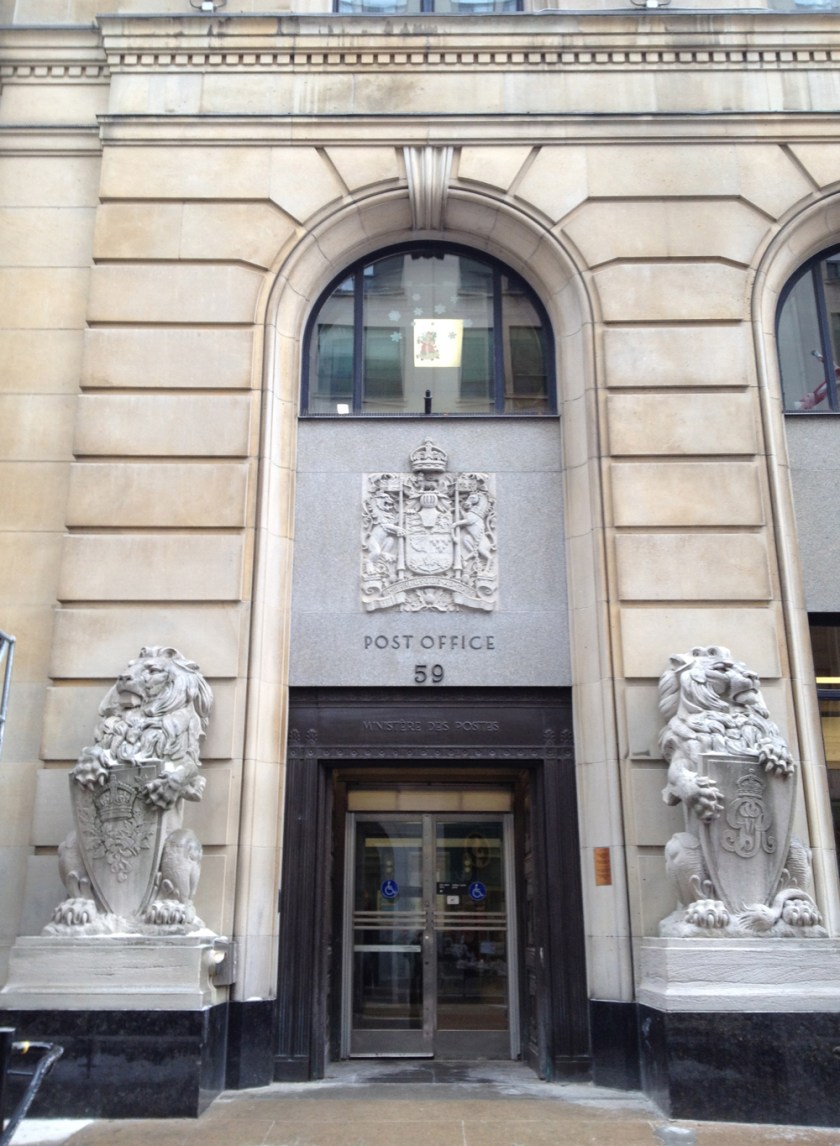
Fortunately these two proud beasts remain on duty at the side door on Sparks St.
Lions on duty
I travelled down Queen Street on the way home. It felt safer than Slater, perhaps because there was only one lane keeping the traffic calm.
Queen St
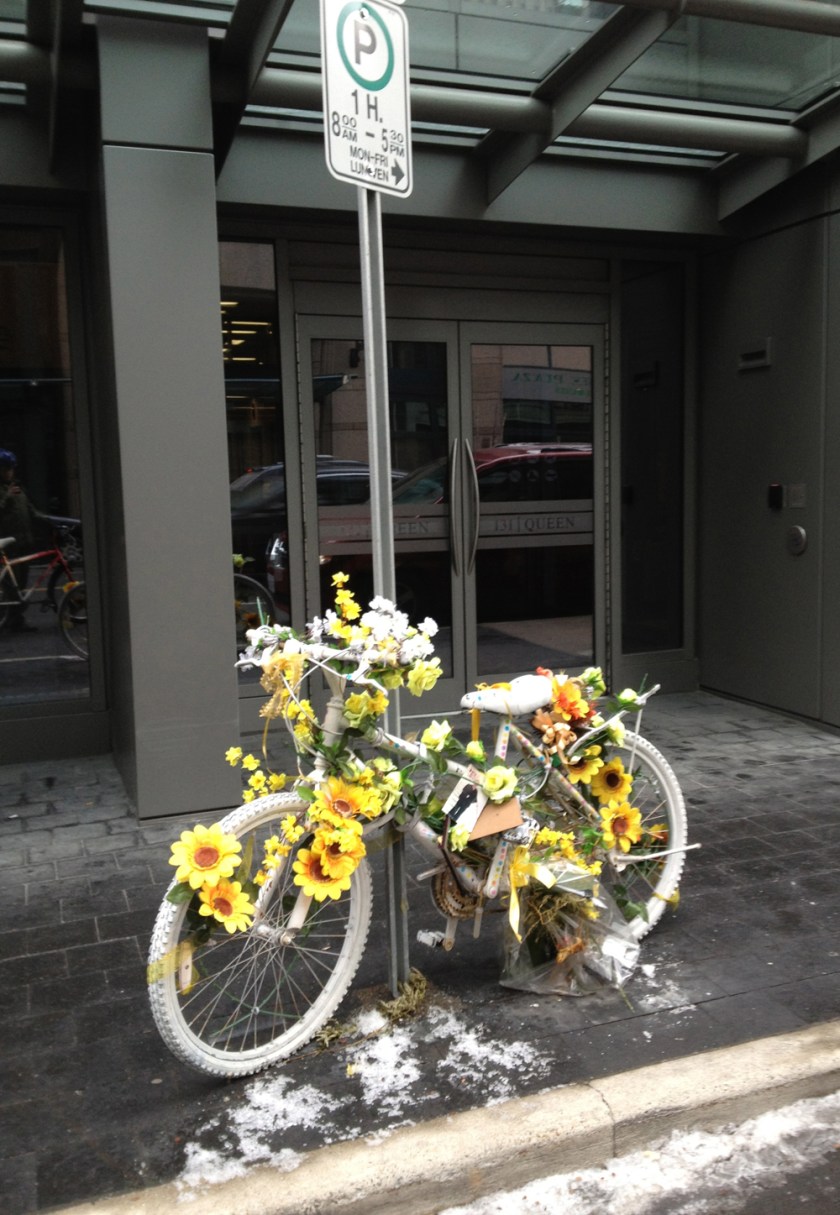
The narrow space between the parked cars and the traffic presents another very real danger of being doored, i.e. when a passenger of a parked car opens their door without checking to see if any bicyclists are coming, forcing a collision. This is what lead to the senseless death of Danielle Naçu in October 2011. Here is the ghost bike along Queen Street commemorating this tragic event.
Commemorative ghost bike
They knocked down part of Christ Church Cathedral awhile ago along with a few other old dwellings to build condo’s, but retained these facades to be incorporated into the new building. I am often fascinated by the juxtaposition of temporary structures used to retain or protect old structures as shown in this image.
Bracing
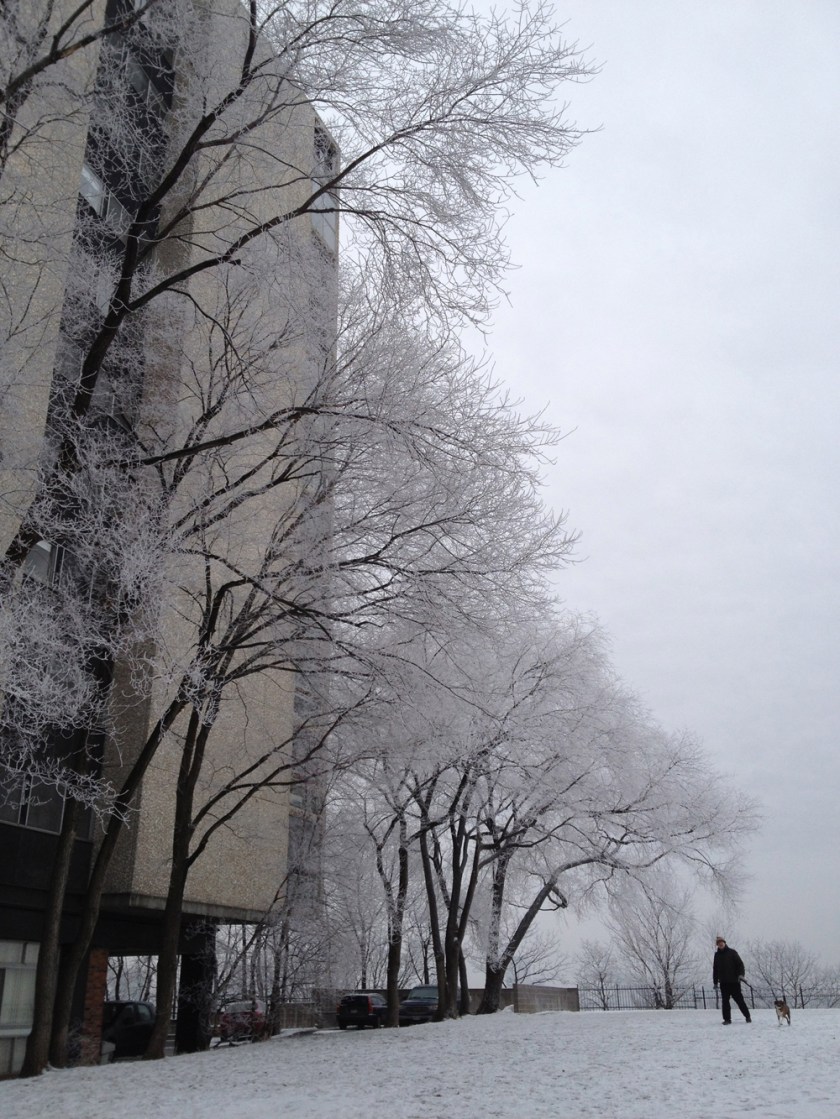
And finally, a shot of Jack Frost’s handiwork, looking out towards the park at the western end of Queen St.
My son had a hockey game out in Vanier last night, so I biked there. Here’s how.
Sandy Hill is full of big old beautiful houses. That’s because Louis Besserer, who owned most of it when Queen Victoria chose Ottawa as the capital in 1857, decided to develop Sandy Hill into THE place to live for rich folk like lumber barons, diplomats and politicians. And it worked. Laurier, MacDonald, Pearson and Mackenzie King each set up residence there at one time. Now a bunch of embassies have settled into a number of these old gems scattered throughout the area, like Poland, at 443 Daly Street, which looks great at night. They light their ornate front porch with its panelled copper ceiling to great effect.
Polish Embassy
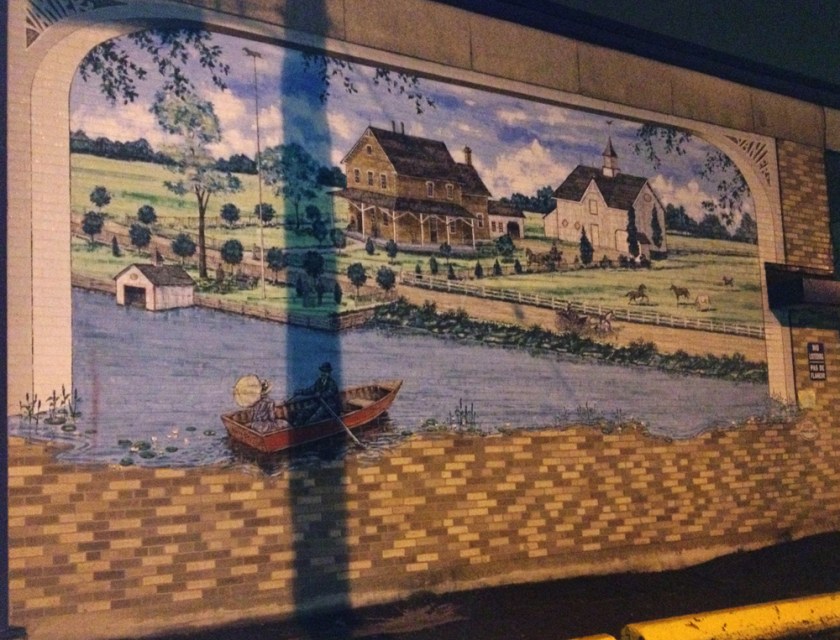
Biking along Montgomery Street in Vanier I noticed a mural on the side of this building, depicting how a Dr Harris’ property along the Rideau River might have looked like back in 1870.
Mural along Montgomery St
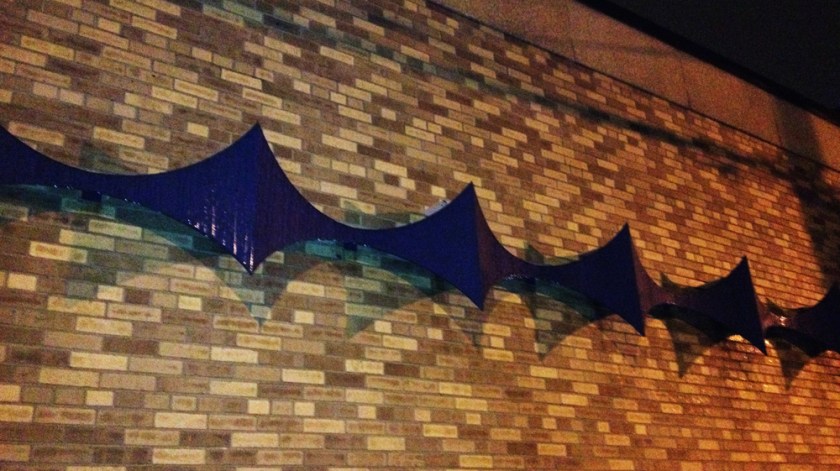
Then I noticed this very funky 60’s style canopy and decorative detail on the same side of the building that have survived the test of time.
Modernist details along Montgomery St
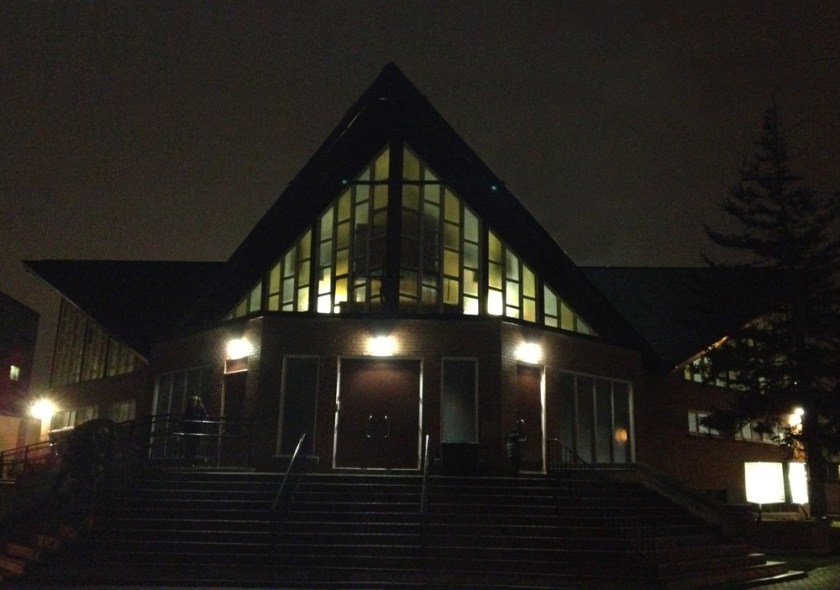
Just before I got to the arena I passed this modernist church on Cyr Avenue, graced with big panels of stained glass.
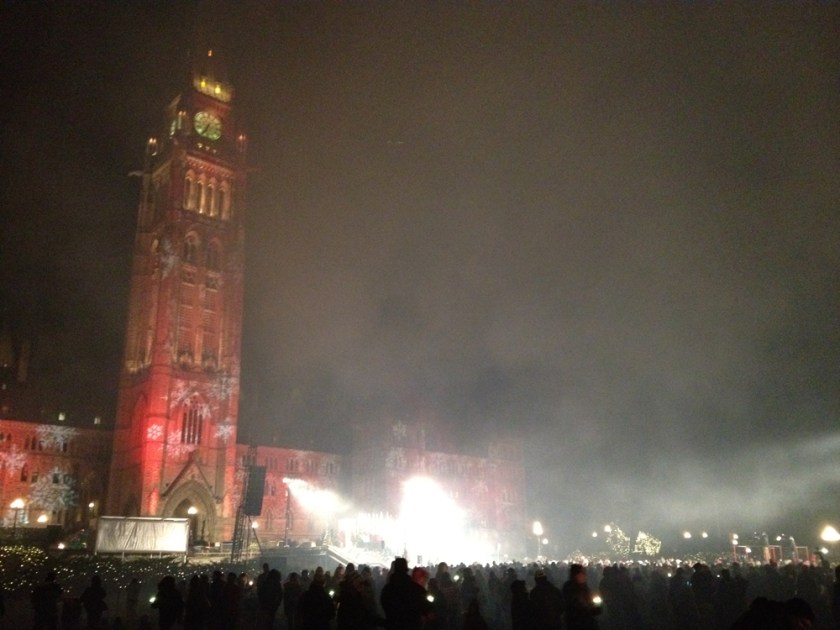
They turned on the annual Christmas lights display along Confederation Boulevard last night, so I checked them out! They will be on every night until January 7th.
Orange line is how I biked to Parliament Hill for the launch. Blue is the route I followed to see most of the official sites.
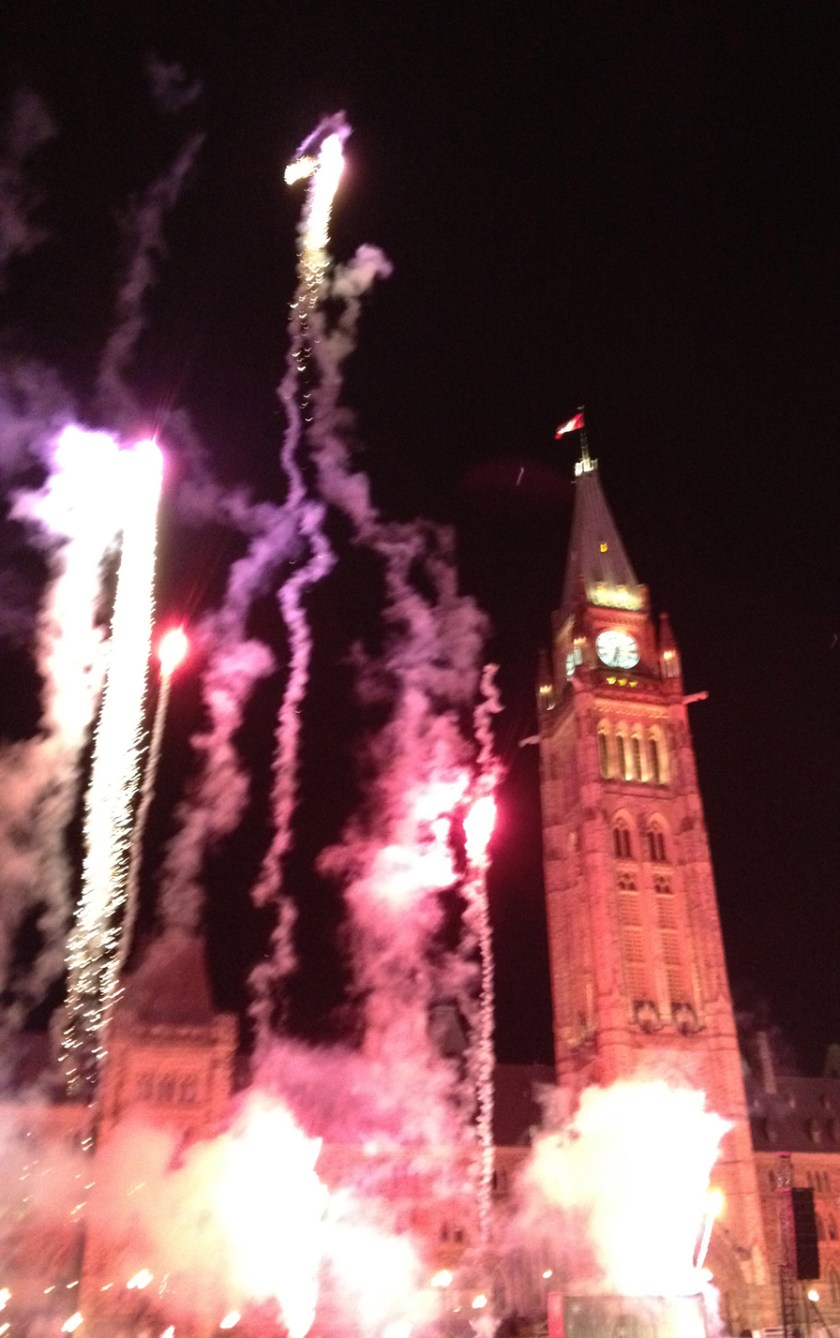
The flipping of the switch was launched with an explosion of mini fireworks.
BOOM!… as the smoke settles.
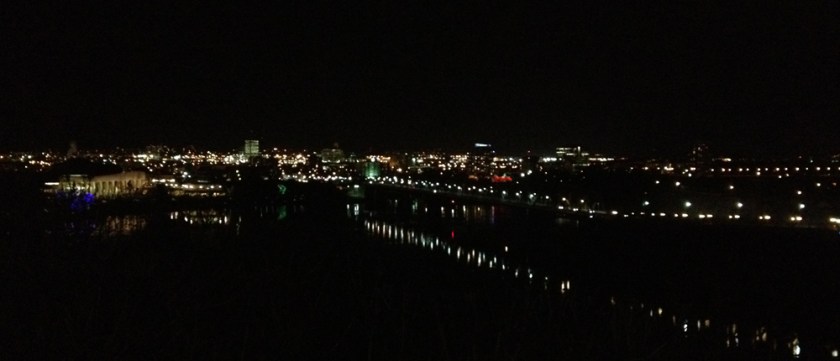
Now the route I’m proposing is full of splendid night time sceneries, with or without Christmas lights. The view from behind the Centre Block across the Ottawa River to Gatineau is one such example. Looking out across the river also gave me my first indication that they’ve considerably scaled back on the number of Christmas lights from previous years.
View across the Ottawa River to Gatineau
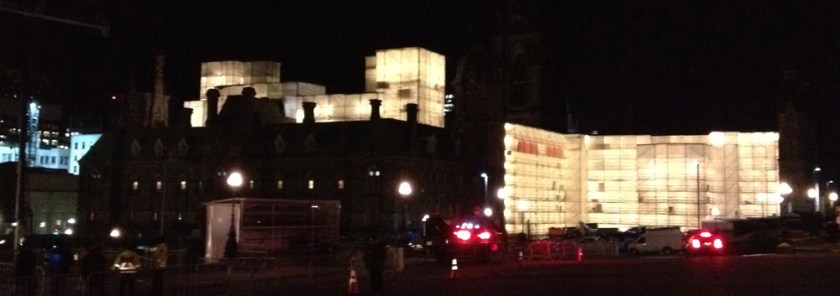
Major renovations are happening on the West Block. Whole sections are wrapped in scaffolding and tarp, creating these internally lit glowing cube structures.
West Block
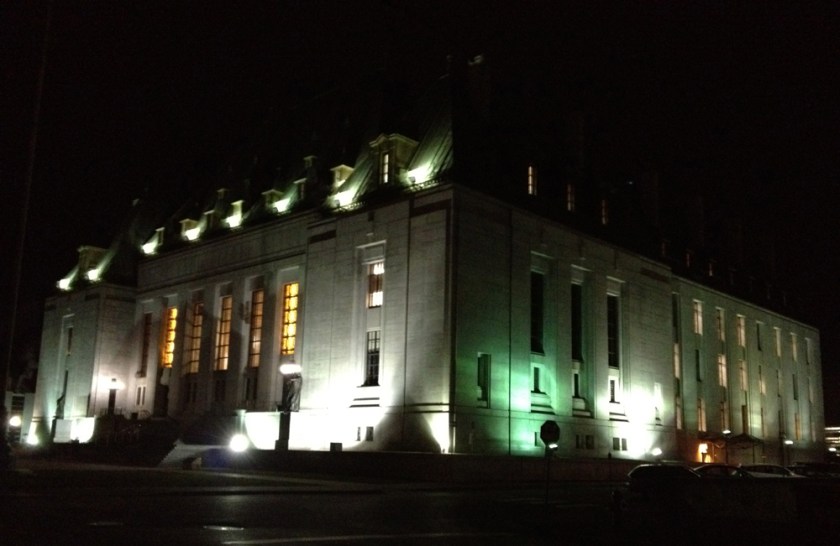
One used to be able to bike in front of the West Block, avoiding having to ride along Wellington, which is not a very bike friendly section of road. Hopefully once the the West Block renovations are completed they will lighten up with the crazy security and once again allow folks to access the hill from the west gate. Otherwise, the first opportunity to get off Wellington is opposite Bank Street, just beyond the closed off gates and line up of parked police cars. First left and a bit further along brings you alongside the wonderfully lit Supreme Court of Canada.
Supreme Court
Continuing straight ahead leads to these stairs down behind the Library and Archives building.
Behind the National Library
Riding around behind the archives building brings you to Wellington right where the designated bike lane begins. Now that’s the way to go!
On the other side of Portage Bridge dip down the bike path to the right where there are some great unimpeded views of the Hill.
View of Hill from Gatineau
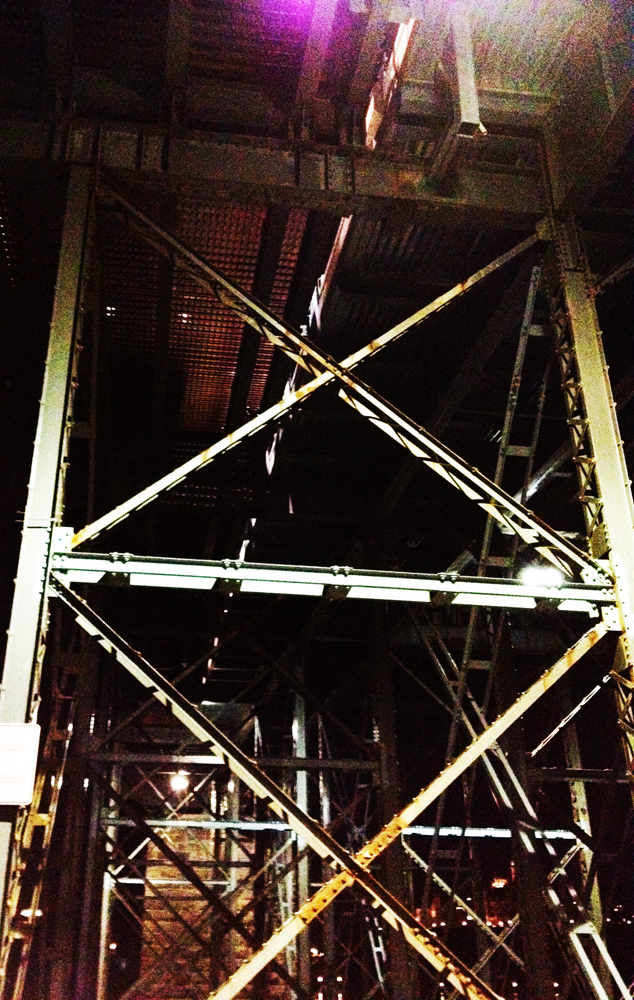
It’s pretty thrilling where the path crosses under the Alexandria Bridge. The whirring sound of the cars on the metal mesh road way above resonates all around you, while the beams from the headlights flash and flicker down through the steel girders.
Under Alexandria Bridge
Out in Jacques Cartier Park there are a few arrangements of lights, including this droopy bunch of red ones hanging way up in a couple of trees.
JCP
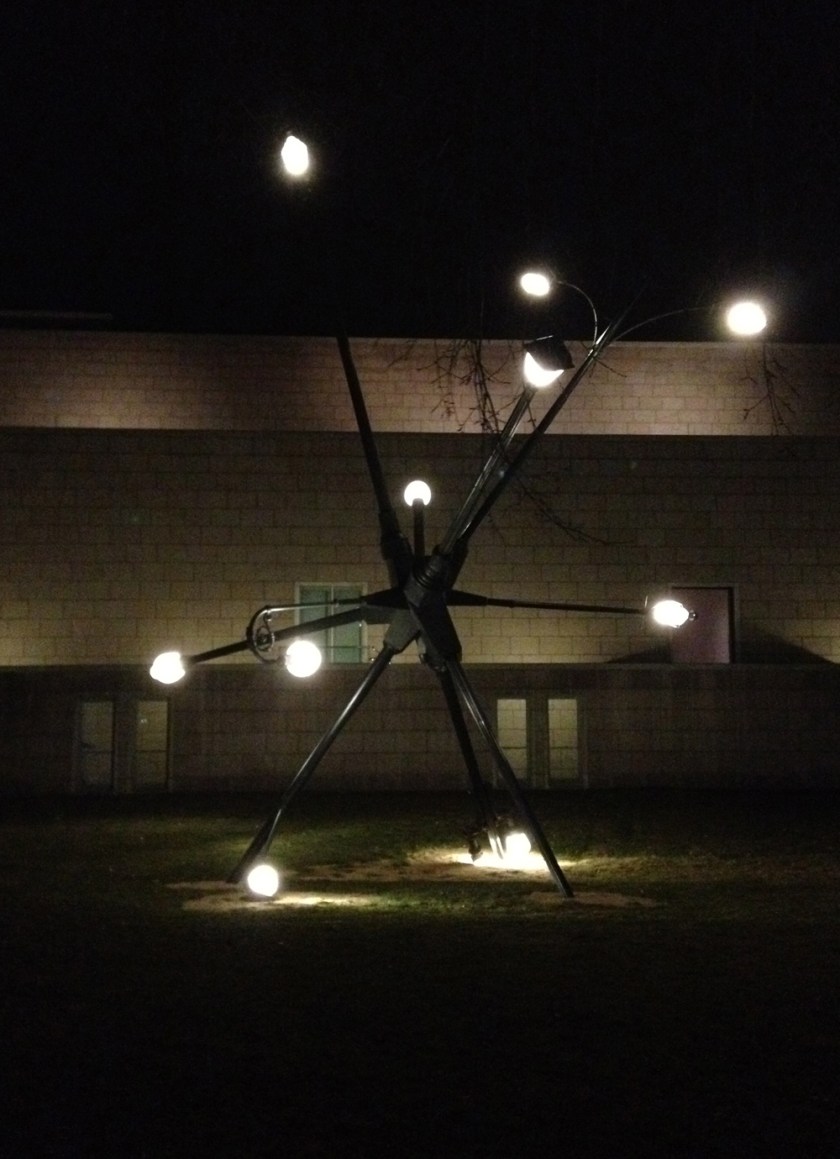
After crossing back over the Alexandria Bridge I turned up behind the National Gallery to re-visit this piece of outdoor sculpture, made up of a number of streetlights blown over by hurricane Katrina. Love it!
Majestic at night
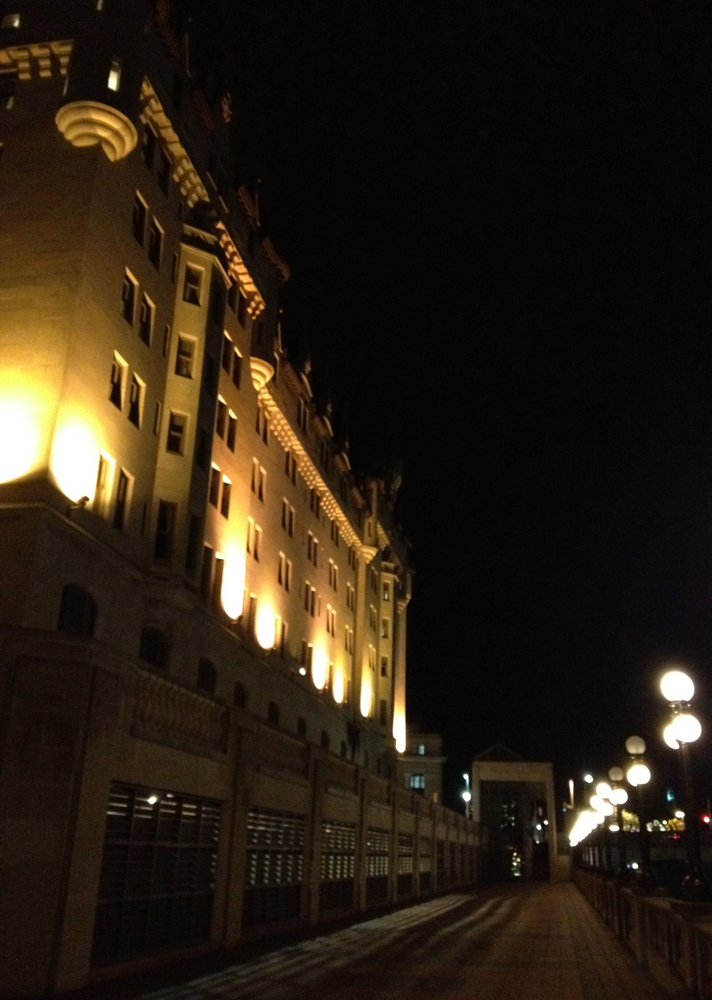
In previous years the trees of Majors Hill Park were filled with lights, but this year, nil. S’okay, still a nice ride along the edge of the cliff. Very pleased to discover the terrace above the canal was still accessible from the park to Wellington, affording this dramatic night time view of the Chateau Laurier. The terrace has been previously closed for the winter.
Look up, look way up…
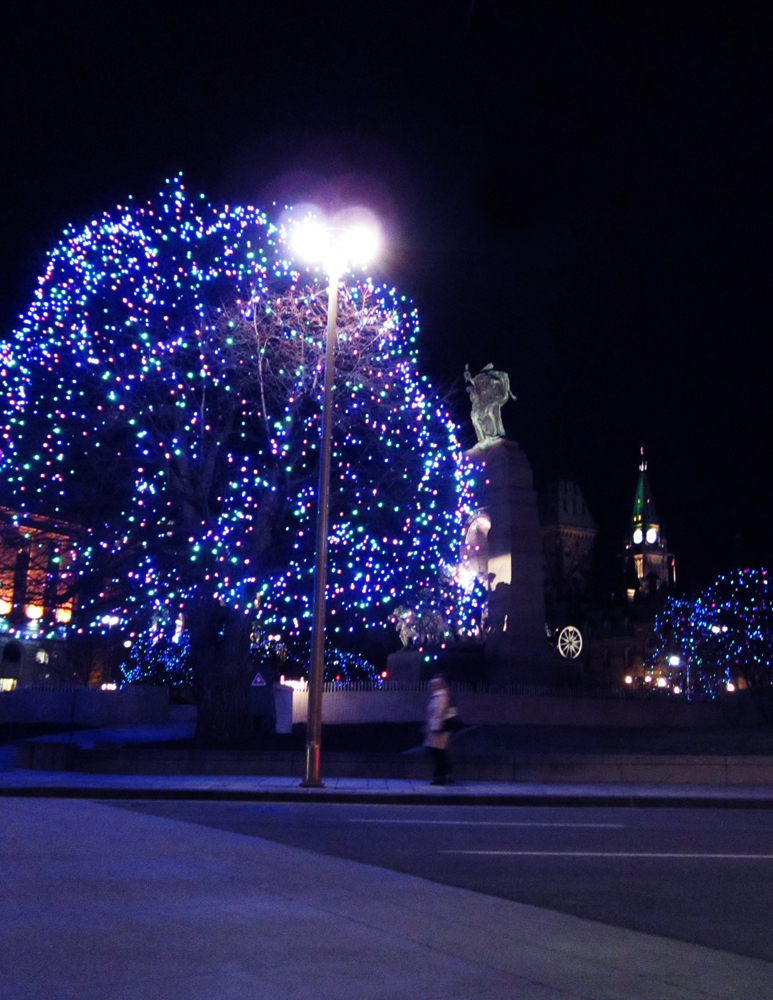
The Cenotaph has lots of cool lights all around it.
Lights at the Cenotaph
Opposite the Cenotaph there is this arrangement of warm lights set against the Conference Centre.
Conference Centrte
The city has added Christmas lights to compliment the exuberantly lit walls of their outdoor rink in front of City Hall.
Rink of Dreams
I end the tour with this photo from Confederation Park looking towards the Lord Elgin Hotel.
Lights in Confederation Park
The only official Christmas Lights site I didn’t get to was the one out near the Governor Generals Residence. I will have to figure out a safe night time route that avoids the dangerous stretch of Sussex between the National Gallery and the External Affairs building.

































 OttawaVeloOutaouais